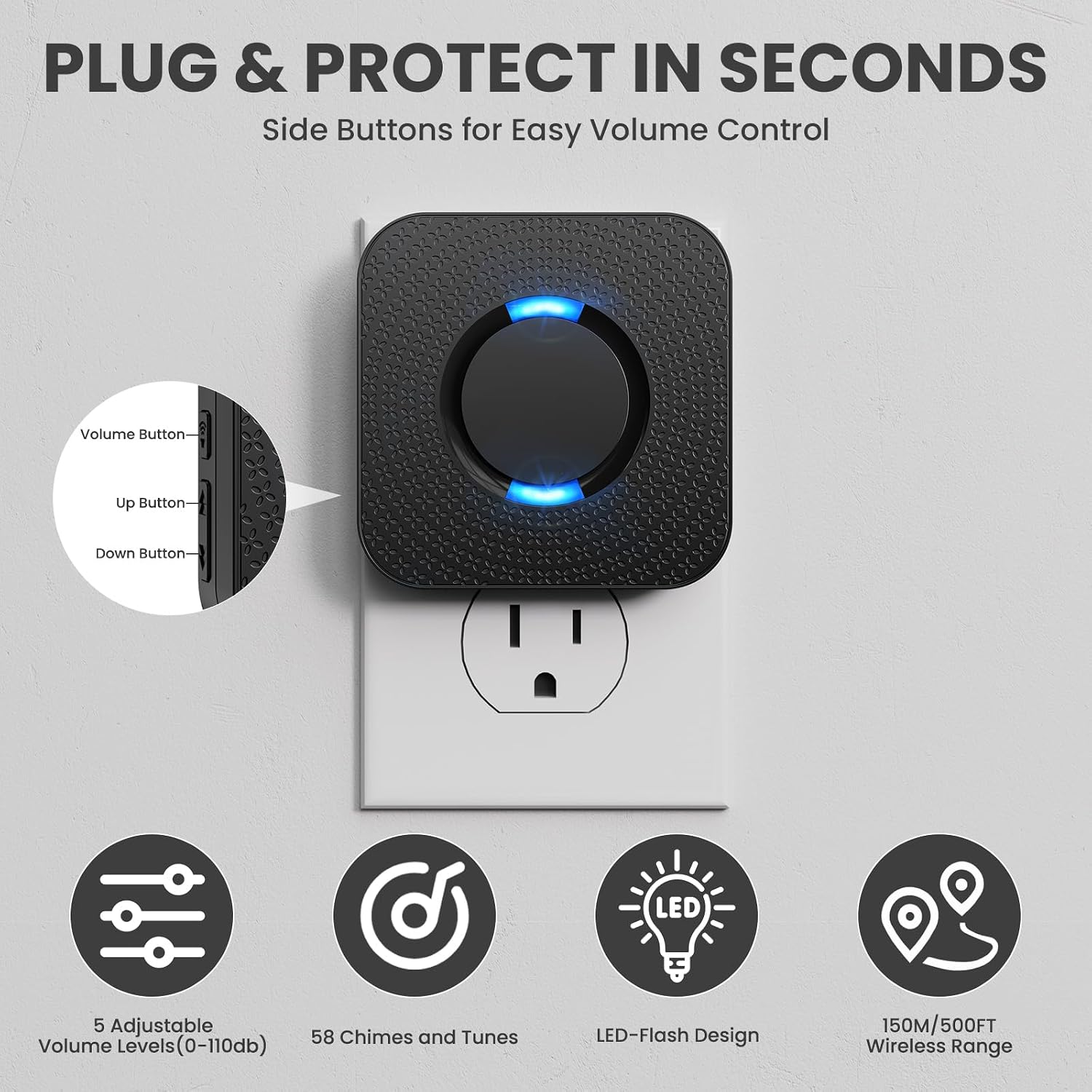
If your driveway or loading dock entrance catches you off guard more than it should, a wireless PIR alarm system is likely the fastest fix you’ll find. PIR stands for passive infrared — the sensor detects the heat signature (infrared radiation) that people, vehicles, and animals emit as they move through its field of view. No active beam, no buried loop, no wiring run to the street. The receiver sits inside and chimes, flashes, or pages you when motion trips the transmitter out by the gate. These systems sell in the $30–$200 range for residential and light-commercial use, and the specs look deceptively simple: range in feet, number of zones, battery life. What the product listing doesn’t tell you is how aggressively those numbers are optimized for the marketing team. This guide breaks down what the specs actually mean, where they mislead you, and how to pick the right system for your specific geometry — whether you’re covering a rural driveway, a warehouse entrance, or a multi-door facility.
What “500-Foot Range” Actually Means (And What It Doesn’t)
The single number that drives most purchase decisions is RF transmission range — the wireless distance between the outdoor sensor/transmitter and the indoor receiver/chime. Virtually every mid-market system (Guardline, Htzsafe, Hosmart, Chamberlain, Dakota Alert) lists this as a headline spec, with values clustering around 500 feet for the $40–$100 tier.
Here’s the catch: per Automation World’s feature on RF range claims versus real-world performance, open-air range figures are measured in line-of-sight conditions with no obstructions, no competing RF traffic, and often with the antenna at optimal elevation. In practice, you’re not deploying on a flat salt flat. You’re installing through:
- Building walls (wood-frame: subtract 30–50%; concrete or masonry: subtract 60–80%)
- Grade changes that interrupt line-of-sight
- Metal structures (gutters, steel siding, HVAC equipment) that reflect and attenuate the 433 MHz or 315 MHz signal most consumer PIR systems use
- Competing devices on the same ISM band — garage door openers, weather stations, other wireless sensors
A system rated at 500 feet open-air might deliver reliable triggering at 150–200 feet through a typical wood-frame house wall and a standard residential door. That’s not a defect; it’s physics. What matters is matching the spec to your path loss budget — the sum of all signal-degrading factors between transmitter and receiver along your actual deployment path.
If you’re evaluating multiple systems, ask this: Does the manufacturer publish the transmit power (in dBm) and receiver sensitivity? Guardline and Dakota Alert both publish these figures in their product documentation. A system with higher transmit power (say, +10 dBm vs. +5 dBm) and higher receiver sensitivity (−100 dBm vs. −90 dBm) will outperform a competitor with a larger headline range number but worse underlying RF specs.
PIR Detection Geometry: The Spec the Listing Buries
RF range tells you how far the alert travels. PIR detection zone tells you what the sensor actually sees. These are independent specs, and conflating them is the most common mistake buyers make.
A PIR sensor works by dividing its field of view into detection segments using a Fresnel lens array — a segmented plastic optic that focuses incoming infrared onto a pyroelectric element. As Electronic Design’s technical reference on Fresnel lens geometry explains, detection occurs when a warm body moves across zone boundaries, not when it simply stands in the field. This has two practical implications:
-
Lateral movement detects best. Direct approach detects worst. A person walking straight toward the sensor may not trigger it until they’re very close, because they’re staying within a single Fresnel segment. The same person crossing perpendicular to the sensor’s axis triggers it at maximum rated distance.
-
Detection angle matters as much as detection distance. Most residential PIR transmitters spec a 110°–120° horizontal detection angle and a fixed vertical angle (often 60°–90°). Narrow that to a driveway funnel and you’re covering a much smaller area than the spec implies.
By the Numbers
| Spec | What Sellers Advertise | What You Should Verify |
|---|---|---|
| RF Range | 500 ft | Transmit power (dBm) + wall loss for your structure |
| PIR Detection Range | 30–40 ft | Lateral detection distance, not head-on approach |
| Detection Angle | 110° horizontal | Effective coverage at 20 ft vs. 30 ft vs. 40 ft |
| Battery Life | 12–24 months | Trigger frequency vs. standby current draw |
The detection range figure for PIR sensors in this class (typically rated 30–40 feet) is almost always measured laterally — a person walking across the sensor’s face at that distance. Expect 15–25 feet of reliable head-on vehicle detection in real conditions, which is still adequate for a driveway if you mount the sensor to catch vehicles crossing perpendicular rather than approaching directly.
Multi-Zone Systems: Where They Add Value and Where They Don’t
Most systems in the $60–$150 range support multiple transmitter zones paired to a single receiver — typically 4 to 8 zones depending on the platform. This sounds powerful, and it can be. But zone architecture hides real tradeoffs worth naming before you commit.
The case for multi-zone: You have genuinely separate entry points — a driveway, a gate, a back entrance, a loading dock — and you want to know which one triggered without walking around. A receiver that announces “Zone 1” versus “Zone 3” gives you that. Dakota Alert’s MURS-HWK system, which operates on MURS radio frequencies rather than the crowded 433 MHz ISM band, is frequently cited by owners in aggregated reviews on Digi-Key and Amazon for its zone differentiation reliability in farm and light-industrial settings.
The case against over-zoning: Every transmitter you add is another battery to maintain, another potential RF collision in dense 433 MHz environments, and another node that false-triggers from wildlife, blowing branches, or reflected heat from sunlit pavement. Control Engineering’s reference on wireless sensor networks in industrial settings notes that dense, low-cost wireless nodes on shared ISM bands see collision rates that increase non-linearly as node count rises — a useful reminder that adding more zones doesn’t just multiply coverage, it multiplies noise.
Practical decision rule: If your coverage needs involve more than four entry points in a space smaller than two acres, or if you need zone identification plus logging, you’ve likely outgrown the consumer PIR alarm category. Look at addressable wireless systems (Honeywell VISTA-series or DSC PowerSeries with wireless expansion) or a dedicated industrial sensor network.
False Trigger Rate: The Spec Nobody Publishes
Here’s what the data sheet will never tell you: how often the system cries wolf.
False positives in PIR driveway sensors come from several sources, and understanding them lets you configure around them rather than fight them:
Thermal clutter: Direct sunlight on pavement, HVAC exhaust vents, and reflective metal surfaces all create moving thermal gradients that cheaper PIR sensors interpret as targets. Sensors Magazine’s PIR fundamentals editorial overview notes that better dual-element pyroelectric sensors cancel common-mode thermal drift — they respond only to differential IR signals across two sensing elements. Look for “dual-element” or “differential pyroelectric” in spec language; many sub-$40 systems use single-element detectors that are more susceptible to thermal noise.
RF interference: On 433 MHz ISM, you share spectrum with everything from remote controls to weather stations. A false trigger here isn’t the PIR misfiring — it’s the receiver latching onto an out-of-band signal. Systems that use signal encoding with rolling codes or proprietary protocol stacks (Guardline uses a proprietary encoding scheme; Dakota Alert MURS products use defined MURS channel assignments) are meaningfully more reliable than systems with simple fixed-code 433 MHz transmitters.
Wind-driven vegetation: Any warm-blooded animal or fast-moving vegetation in the detection zone is a trigger candidate. Adjusting detection sensitivity (most units have a trim pot or DIP switch) and narrowing the detection angle with a lens shield or mounting angle change addresses this before you blame the sensor.
Mounting and Deployment: Where Most Installs Go Wrong
You can buy the right sensor and still ruin the performance with poor placement. Based on published installation guidance from manufacturers including Guardline, Htzsafe, and Dakota Alert, and consistent with owner feedback patterns across aggregated reviews, the failure modes are predictable:
-
Mounting too high: Sensors mounted above 6 feet gain detection range but lose near-field coverage. Vehicles or people entering from a tight angle will pass under the detection cone. Optimal mounting height for most residential/commercial PIR driveway sensors is 4–6 feet, angled slightly downward.
-
Pointing into sun exposure: A west-facing sensor aimed east will catch morning sun directly. A south-facing sensor in a hot climate will be fighting background thermal load all afternoon. Orient the sensor to minimize direct solar exposure in the lens.
-
Placing the receiver far from the transmitter without signal mapping: Walk the RF path with a test transmission before committing to a mount location. Guardline’s installation documentation specifically recommends a range test before final installation — it takes three minutes and saves an hour of troubleshooting later.
-
Skipping the tamper check: Most systems include a low-battery indicator, but owners in long-run reviews on Amazon consistently note that low-battery conditions often manifest as false triggers or missed detections before the indicator fires. Set a calendar reminder for battery inspection at six months regardless of what the spec says.
If X, Then Y: Decision Rules for Your Situation
Rather than picking a system by brand loyalty or headline spec, use these decision gates:
If your RF path crosses more than one masonry or concrete wall: Prioritize transmit power and receiver sensitivity specs over advertised range. Target systems with published −100 dBm or better receiver sensitivity. Consider a MURS-band system (Dakota Alert) if 433 MHz congestion is an issue in your area.
If your detection geometry requires catching direct-approach vehicles: Mount two sensors at a V-angle flanking the driveway approach so lateral detection covers the entry path, rather than relying on one sensor aimed head-on.
If false trigger rate is your primary pain point: Specify a dual-element PIR detector with adjustable sensitivity and proprietary RF encoding. Don’t default to the lowest-cost 433 MHz option.
If you need more than four zones with event logging: You’ve outgrown consumer wireless PIR alarms. Move to a panel-based addressable wireless system or an industrial sensor network appropriate to your facility.
If you’re covering a genuinely open rural driveway with no walls in the RF path: Almost any system in the $50–$120 range will meet or exceed its advertised range. In that context, spend your evaluation time on detection geometry and false-trigger resistance rather than RF specs.
The 500-foot range claim isn’t a lie — it’s a measurement taken under conditions that probably don’t match yours. Understand the underlying RF and PIR physics, verify the specs that matter for your specific deployment path, and you’ll get a system that works reliably rather than one that looked good on a product listing.