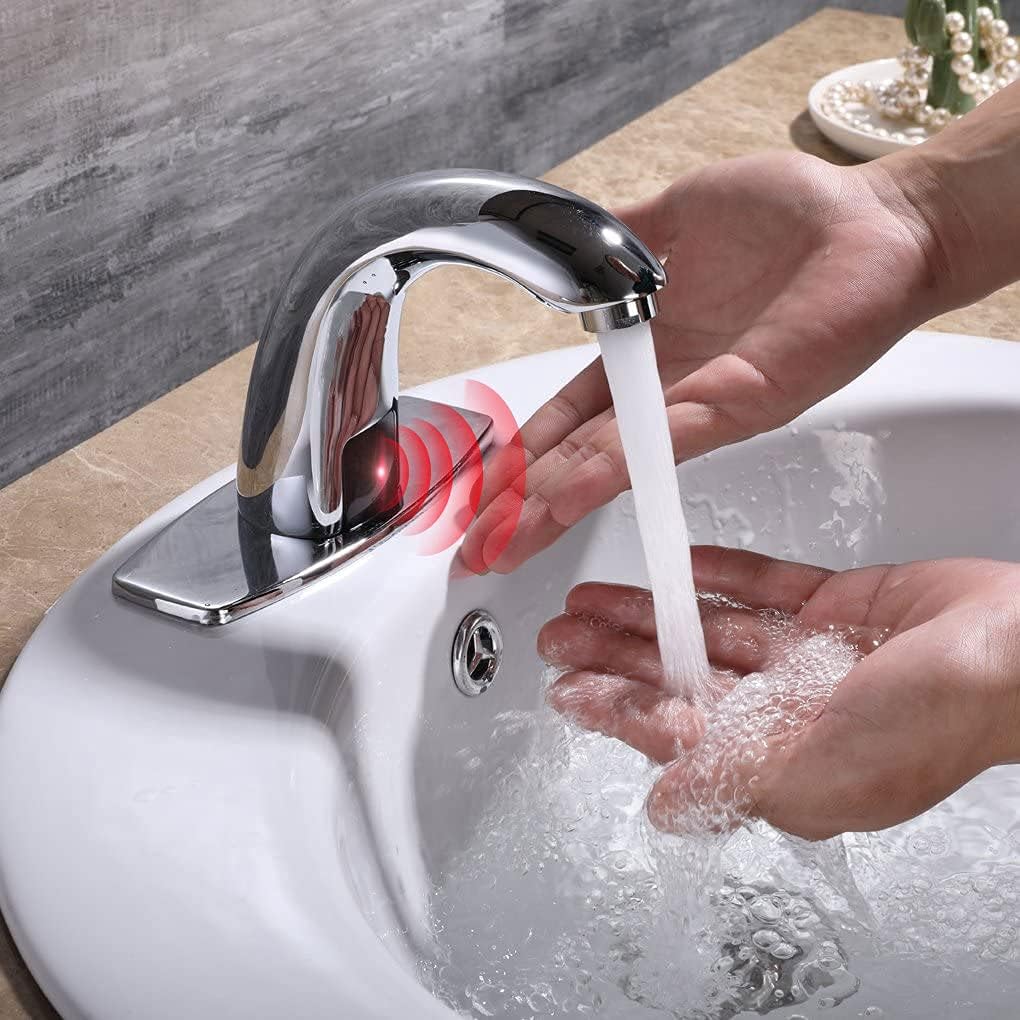
A touchless faucet uses an infrared (IR) proximity sensor — a short-range detector that bounces a beam of light off your hands and triggers the water valve automatically — so nobody has to grip or twist anything to get water flowing. If that sounds like a niche convenience, consider this: a parent whose child has cerebral palsy and can’t close their fingers, a restaurant owner who just watched a health inspector cite a competitor for cross-contamination, or a plumber who needs a code-compliant fixture in a high-traffic public restroom by Friday. For all three, the same $40–$150 consumer unit from the home-improvement aisle raises the same question: Is this actually good enough, or am I going to regret it in six months? This guide answers that question with real owner data, published specs, and a decision framework you can act on today.
Who’s Actually Buying These, and What They Need
Before you pick a SKU, it’s worth naming the three buyer types that show up repeatedly in aggregated owner reviews, because the right answer genuinely differs by use case.
Accessibility buyers — parents of special-needs children, adult children outfitting a home for an aging parent, or occupational therapists specifying fixtures — are primarily concerned with detection range and sensor geometry. Standard touchless faucets are calibrated to detect a hand waved directly under the spout at 2–4 inches. That works fine for an able-bodied adult, but it fails a user who can only extend a forearm from the side, or whose hand tremor makes precise positioning unreliable. The ADA Standards for Accessible Design (Section 606) require operable parts to be usable with a closed fist and one hand, but they don’t mandate a specific sensor detection angle — so ADA compliance alone doesn’t guarantee usability for every mobility profile.
Infection-control buyers — small-business owners, food-service operators, and facility managers — care about durability under continuous cycling and the elimination of touch points. The Centers for Disease Control and Prevention’s Hand Hygiene in Healthcare Settings guidance explicitly identifies shared faucet handles as a fomite (a surface that can harbor and transfer pathogens) transmission vector. Even in non-clinical settings, removing a hand-contact point at the sink is a measurable intervention. The practical question is whether a consumer-grade unit can handle the cycle count a commercial restroom demands.
Licensed tradespeople and commercial specifiers — and this is the credibility signal worth taking seriously — are increasingly installing budget touchless units not as a long-term plan, but as a stopgap when a Sloan or equivalent commercial unit has a six-week lead time. One licensed plumber in a widely cited aggregated review thread describes installing a budget touchless unit as a temporary measure, then leaving it permanently after it outperformed the name-brand unit it was meant to replace. That’s not a universal endorsement, but it tells you something about where the quality floor has moved.
Key Specs and the Tradeoffs You Need to Name Explicitly
Power Source: Battery vs. AC
This is the decision that causes the most post-install regret, so name the tradeoff directly.
Battery-powered units (typically 4×AA or 6×AA alkaline) are easier to install — no outlet required — and they continue working during a power outage. The weakness is cycle-count sensitivity. In a private home bathroom, 4–10 activations per day, a fresh set of alkalines lasts 12–18 months per most manufacturer specs. In a commercial restroom with 80–150 activations per day, owners consistently report battery life dropping to 4–8 weeks, which creates a recurring labor and consumables cost that most buyers don’t account for at purchase time.
AC plug-in or hardwired units eliminate the battery drain problem entirely. In high-traffic commercial settings, aggregated reviews show significantly higher long-term satisfaction ratings for plug-in units. The installation constraint is a GFCI-protected outlet under the sink — required by most local electrical codes for any outlet within 6 feet of a water source. If that outlet doesn’t exist, you’re adding an electrician to the project cost.
By the Numbers
| Setting | Daily Activations (est.) | Battery Life (AA alkaline) | Recommended Power |
|---|---|---|---|
| Private/home bath | 5–15 | 12–18 months | Either |
| Small-business restroom | 40–80 | 6–12 weeks | AC plug-in |
| High-traffic commercial | 100–200+ | 3–6 weeks | AC hardwired |
Estimates derived from manufacturer datasheets and aggregated owner review patterns; your actual results depend on sensor dwell time and solenoid valve efficiency.
Sensor Sensitivity and Phantom Activation
If your touchless faucet activates every time someone walks past the sink, the sensor’s detection field is either too wide or the sensitivity threshold is set too low. Most consumer units ship at maximum sensitivity — the manufacturer is optimizing for “it always detects a hand” rather than “it only detects a hand.” In a narrow bathroom, a motion event 18–24 inches from the sensor can trigger the valve.
The fix is adjustable sensitivity. Not all units offer it. Before purchasing, check whether the spec sheet or manual includes a sensitivity adjustment — many units hide a small potentiometer (a tuning dial) inside the battery compartment or under a cover plate. Owners who find and use this adjustment report significantly fewer phantom activations. If the unit has no adjustment mechanism and you’re placing it in a narrow space, that’s a genuine compatibility problem, not a defect you can work around.
Fit Problems: Cover Plate Sizing
One consistently surfaced installation problem in owner reviews involves sink deck fit. Standard U.S. residential and light-commercial sink decks have a 1-3/8” diameter faucet hole (single-hole) or a 4” center spread for three-hole configurations. Many budget touchless units ship with a cover plate (escutcheon) designed for a 1-3/8” hole — but if your existing sink has a slightly larger knockout or a non-standard foreign-manufactured hole pattern, the cover plate won’t bridge the gap. Reviewers of the PRIMSOPH unit specifically call this out: the included cover plate is too small for a number of common sink hole patterns, leaving an unsightly gap around the base.
Before ordering, measure your existing hole diameter and center-to-center spread if you have a three-hole sink. If the spec sheet doesn’t list cover plate outer diameter, contact the manufacturer before purchase — this is a $5 measurement that prevents a $40 return.
Installation Traps Experienced Buyers Still Hit
Even licensed plumbers who’ve installed dozens of touchless units report one recurring error: overlooking the rubber washer at the supply hose connections. The sequence is consistent across reviews: Unit 1 leaks, installer reseats the hose, leak stops. Unit 2 or Unit 3 installed later also leaks — because the installer, now confident in the process, doesn’t check whether the washer is seated or even present. Some units ship with washers in a separate bag. Some washers are loose inside the hose packaging. A missing or cocked washer at a braided stainless supply connection will produce a slow drip that goes undetected until it damages the cabinet below.
The PHCC’s Touchless Fixture Specification and Installation Guide recommends a finger-tight-plus-quarter-turn installation protocol for flexible supply hoses, with explicit washer inspection before torquing. Follow that protocol for every connection on every unit, regardless of how many you’ve done.
The Noise Issue and Production Revisions
A separate and underreported problem is audible flow noise — a high-pitched whine or vibration when water runs. This is almost always a solenoid valve issue: the valve’s internal orifice creates turbulence at certain flow rates and water pressures. In well-documented owner reviews for the Greenspring touchless faucet line, early production units generated consistent noise complaints. Greenspring responded by shipping redesigned units to affected buyers. This is worth flagging for two reasons: first, it’s a positive customer-service outcome that signals the manufacturer takes feedback seriously. Second, it means buyers should verify they’re receiving a current-production unit, not old inventory. Ask the seller or check the product listing for a note about revised hardware; if the unit arrives and produces significant flow noise, contact the manufacturer before returning it — a replacement valve or redesigned unit may be the faster resolution.
Can a Budget Unit Actually Replace a Sloan in a Commercial Setting?
This is the question licensed tradespeople and facility managers most want a straight answer on. Here it is:
For light-to-moderate commercial use (under 80 activations/day), a quality consumer touchless unit with AC power can perform reliably. NSF/ANSI 61 certification (which ensures materials won’t leach contaminants into drinking water) is the minimum bar — confirm this before specifying for food service or healthcare-adjacent settings. Most reputable touchless faucets in the $60–$150 range now carry NSF/ANSI 61 compliance, per NSF International’s public certification database.
For high-traffic public restrooms, the calculus changes. A commercial-grade unit from Sloan, American Standard, or equivalent is engineered for 500,000+ cycle lifespans with serviceability — replaceable solenoids, available repair kits, and warranty support calibrated for institutional buyers. Consumer units are typically rated for 100,000–200,000 cycles and are designed for replacement, not repair. If you’re specifying for a facility where downtime or a maintenance call is a significant cost, the per-unit price difference between a $90 consumer unit and a $400 commercial unit is not the right comparison; the total cost of ownership including replacements and labor is.
The decision rule: If you need a single-restroom solution for a small business, salon, or low-to-medium traffic office, a well-reviewed consumer unit with AC power and NSF/ANSI 61 certification is a legitimate commercial-grade choice. If you’re specifying for a high-traffic public restroom or a setting with AHJ (authority having jurisdiction) inspection requirements for commercial fixtures, specify a commercial-grade unit and document the compliance path.
Frequently Asked Questions
Will a touchless faucet work for someone with limited hand mobility who can’t wave directly under the spout?
It depends on the unit’s sensor detection angle and range, not just its sensitivity setting. Standard units are optimized for direct overhead detection. For users who can only extend a forearm or approach from the side, look for units that advertise a wider detection cone (some spec sheets list a 120° detection angle vs. a 60° standard). If the manufacturer doesn’t publish this spec, that’s a red flag for accessibility use. Contacting the manufacturer’s technical support line with your specific mobility constraint before purchase is a reasonable step.
How do I stop the faucet from activating when someone walks past?
Locate the sensitivity adjustment (usually a potentiometer in the battery compartment or under a cover plate) and reduce it one step at a time until phantom activations stop while genuine hand detection still works. If the unit has no adjustment, relocate it away from high-traffic paths, or choose a replacement with an adjustable threshold.
Is battery power or AC plug-in power more reliable for a high-traffic commercial restroom?
AC plug-in, without qualification. Battery drain in high-cycle commercial settings creates a maintenance burden that most operators underestimate at purchase. If a GFCI outlet doesn’t exist under the sink, budget for the electrical work — it’s the right infrastructure investment.
What causes leaks at supply hose connections, and how do I prevent it?
A missing, misaligned, or pinched rubber washer at the hose-to-valve or hose-to-supply connection. Inspect the washer before every connection, seat it flush, and use the finger-tight-plus-quarter-turn protocol. Don’t assume the washer is present because it was present on the last unit you installed.
Can a budget touchless faucet replace a Sloan or commercial-grade unit?
For low-to-moderate commercial traffic with AC power and NSF/ANSI 61 certification, yes — with the caveats on cycle life and repairability noted above. For high-traffic public restrooms or code-inspected commercial facilities, specify a commercial-grade unit and document compliance.
Why is my new touchless faucet making a loud noise when water runs?
Almost certainly a solenoid valve turbulence issue, often related to supply pressure. Check whether your supply pressure exceeds the unit’s rated maximum (most consumer units are rated to 80 PSI). If pressure is within spec, contact the manufacturer — some units have had production revisions that address this, and a replacement valve or revised unit may resolve it without a full return.