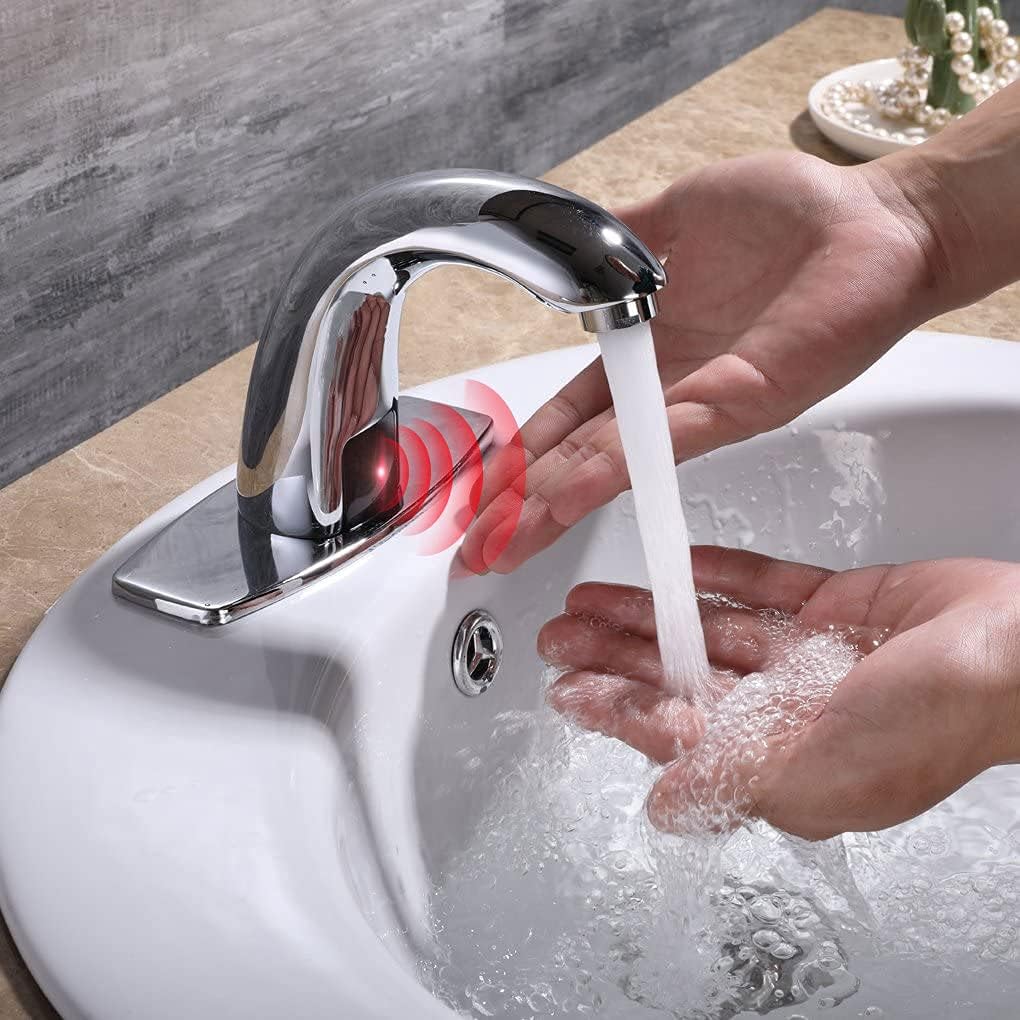
A touchless faucet — also called an automatic or sensor faucet — opens its water valve the moment an infrared (IR) proximity sensor detects your hand beneath the spout, and closes it when you pull away. No handle contact required. That matters for obvious hygiene reasons, but the buyers showing up in long-run owner reviews are often caregivers: a parent of a child with motor-skill limitations, or an adult child retrofitting a bathroom for an elderly parent with arthritic hands who can no longer grip a lever reliably. If either of those scenarios describes your situation, or if you’re speccing restrooms for a small-business retrofit and want to cut water waste without pulling permits for full commercial fixtures, this guide is for you. We’ll walk through what the specs actually mean, where the failure points hide, and how to make a confident purchase without getting burned by a first-generation unit that was quietly redesigned mid-run.
| EDITOR'S PICKTouchless Bathroom Sink Faucet… | Mid-tierCharmingwater Touchless Bathroo… | Budget pickTouchless Bathroom Sink Faucet | |
|---|---|---|---|
| Power | Battery | — | Battery or Plug-in |
| Control Box | ✗ | — | ✓ |
| Temp Mixer | ✗ | — | ✓ |
| Hole Cover | ✗ | ✓ | — |
| Application | Commercial | — | Commercial |
| Finish | Chrome | Chrome | — |
| Price | $99.99 | $89.29 | $34.39 |
| See on Amazon → | See on Amazon → | See on Amazon → |
How the Sensor Actually Works — and Why Range Matters More Than You Think
Every residential and light-commercial touchless faucet on the market uses an active infrared proximity sensor: an IR LED emits a beam, and a photodetector watches for the reflected signal. When reflectance crosses a threshold — your hand broke the plane — the microcontroller fires the solenoid valve open. Per Sensors Magazine’s overview of IR sensing in consumer plumbing fixtures, the practical detection window in consumer-grade units runs roughly 2–6 inches (5–15 cm), set at the factory. That range is deliberately conservative to prevent phantom triggers from countertop clutter or a running stream of water, which can scatter IR energy.
Why the range number matters for your use case:
- A caregiver application (elderly user, limited mobility) needs the longest reliable detection range and the widest angular acceptance. A user who waves imprecisely or holds their hand high above the basin will frustrate a sensor tuned for a narrow 4-inch sweet spot.
- A high-traffic small-business restroom needs a sensor that recovers quickly between users (fast response time, typically <0.5 seconds in well-reviewed units) and has hysteresis tuned tightly enough to avoid running between users who step close to the counter.
- A kitchen faucet application needs adjustable range or a mode that keeps the valve open while your hands are visibly working (some units offer a manual override mode for filling pots).
Most consumer datasheets don’t publish detection angle in degrees — they publish a single sensing distance. When a spec sheet says “sensor range: 6 cm–15 cm adjustable,” that’s your signal the unit has an onboard trim potentiometer or button-cycle calibration. That feature is worth paying for if your installation geometry is non-standard (deep basin, low counter, pediatric height).
Valve Longevity: The Spec Nobody Advertises
This is the most under-reported issue in this category, and owner reviews surface it more reliably than any product listing will. The internal component that actually controls water flow is a solenoid valve — an electromagnet that lifts a rubber diaphragm or plunger to open the water path, and releases it to close. Solenoid valves have a rated cycle life, and in residential-grade touchless faucets, manufacturers rarely publish this number.
The American Society of Plumbing Engineers’ 2024 technical bulletin on solenoid valve service life notes that low-cost solenoid assemblies in residential plumbing fixtures are typically rated for 200,000–500,000 actuations under clean water conditions at specified pressure. At 50 actuations per day (a busy household), that’s 10–27 years — reasonable. At 300 actuations per day (a small-business restroom with steady foot traffic), you’re looking at 1.8–4.5 years before the valve reaches its design cycle limit.
The harder problem: in many consumer-grade units, the solenoid valve is not sold as a serviceable replacement part. Verified buyers of at least one popular model report that after two of four installed units developed internal valve leaks over time, there was no path to ordering a replacement valve assembly — the only option was full unit replacement. Before you buy multiples for a commercial installation, search the manufacturer’s website and major distributor listings for a published replacement valve SKU. If you can’t find one, budget for full-unit replacement at end-of-valve-life.
Plant Engineering’s 2023 analysis of solenoid coil failure modes identifies heat accumulation and voltage fluctuation as the two leading causes of premature coil failure — both of which are worse in battery-powered units where voltage sags as cells discharge. This connects directly to the power supply decision below.
By the Numbers: Valve Life at Different Usage Rates
| Daily Actuations | Usage Context | Cycles to 300K | Estimated Life |
|---|---|---|---|
| 30 | Single-person home | ~27 years | Low concern |
| 80 | 3–4 person household | ~10 years | Acceptable |
| 300 | Small business restroom | ~2.7 years | Plan for replacement |
| 600 | High-traffic commercial | ~1.4 years | Use commercial-grade fixture |
AC Power vs. Battery Operation: Show the Math
This is the decision that creates the most post-purchase regret in this category. Here’s the actual trade-off:
Battery-only models use 4–6 AA or AAA alkaline cells. The draw profile is a short, high-current pulse each time the solenoid fires, with near-zero quiescent current between actuations. Design News’s 2024 coverage of battery chemistry in low-power actuator circuits notes that alkaline cells handle these pulse loads adequately when fresh, but internal resistance rises as cells discharge — meaning the solenoid receives lower peak voltage late in the battery’s life. At reduced voltage, the valve may not open fully (weak flow) or may fail to seat properly on close (slow drip). More critically, owners report that allowing batteries to run completely flat can damage the solenoid coil — the control board’s low-battery cutoff, if present, is your protection, and not all units implement it reliably.
For a residential installation where you’ll change batteries once or twice a year and you don’t want to run a power cable under the sink, battery operation is fine. Set a calendar reminder at six-month intervals. Don’t ignore the low-battery indicator.
For a small-business or commercial restroom, AC power (typically a 6V DC wall adapter plugged into the cabinet outlet under the sink) is the correct answer. Stable voltage means consistent solenoid actuation force across the entire day, lower heat stress on the coil, and no degraded-battery failure mode. The installation is slightly more involved — you need an outlet under the sink, which most commercial restrooms already have — but the long-run reliability difference is not subtle.
The decision rule: If the faucet will see more than 100 actuations per day, or if the installation is in a location where battery neglect is likely (a break-room sink that nobody “owns”), choose AC power. For everything else, batteries are acceptable with scheduled replacement.
Installation Leak Points: What Owner Reviews Consistently Flag
Across aggregated owner reviews, the most common post-installation leak is not the solenoid — it’s the braided supply hose connections and the rubber washer seating at those connections. One verified buyer documented a scenario that will be familiar to anyone who has installed plumbing fittings at volume: a first unit installed perfectly, a second unit from the same order leaked at the hose connection — attributing the failure to a washer that didn’t seat flat on a slightly inconsistent stamping. This is a manufacturing tolerance issue, not a design flaw, but it means you should inspect the rubber washer in every fitting before assembly, and hand-tighten plus a quarter-turn rather than torquing hard (which can distort a marginal washer further).
Pre-installation checklist to prevent the most common leak causes:
- Inspect both supply hose washers visually — they should be flat, centered, and free of nicks or overmolding flash.
- Hand-thread all connections before applying any tool torque.
- Turn water on slowly and watch for 60 seconds before routing hoses.
- Check again at 24 hours — thermal cycling from the first use often reveals a marginal seat.
Apartment Therapy’s 2025 touchless faucet roundup notes that installation is consistently rated as the category’s strongest user-experience positive, typically taking 20–40 minutes for someone comfortable with basic plumbing. The leak issue is real but preventable with the inspection step above.
Noise and Revised Units: Know What You’re Receiving
One product category worth flagging for practitioners buying at quantity: at least one widely-sold touchless faucet model had a documented acoustic noise issue — a audible hum or buzz from the solenoid during actuation — that generated enough negative reviews for the seller to redesign the unit and issue updated stock. Reviewers who received the redesigned unit updated their ratings dramatically (one documented update from 1 star to 5 stars). This matters for two reasons:
- You may receive old stock. Distributor warehouses and fulfillment centers rotate inventory on FIFO or FEFO, not by revision level. If you’re ordering after a known redesign, ask the seller for the revision date or manufacture date on the unit before shipping.
- Early reviews do not reflect current product. If you’re reading a product’s review history and see a cluster of negative reviews followed by a wave of positive ones and a seller note about a “new version,” treat the positive reviews as the operative data — but verify you’re getting the current build.
If noise is a concern for your application (a quiet office restroom, a healthcare environment), ask specifically before ordering at quantity. A short pilot order and inspection before full deployment is worth the lead time.
Frequently Asked Questions
Can I buy replacement valves separately if the solenoid starts leaking?
In most consumer-grade touchless faucets, no — replacement solenoid valve assemblies are not sold as separate service parts. Before purchasing multiple units for a facility installation, verify whether the manufacturer lists a replacement valve SKU on their website or through distributors. If no replacement part exists, factor full-unit replacement cost into your total cost of ownership model.
Is AC power or battery operation more reliable long-term for a commercial bathroom?
AC power is reliably the better choice for commercial use. Stable DC voltage from a wall adapter maintains consistent solenoid actuation force throughout the day and eliminates the degraded-battery failure mode — where a discharged battery provides insufficient voltage to fully seat the valve on close, causing drips. If your restroom already has an outlet under the sink (most do), there’s no compelling reason to choose battery operation at commercial usage rates.
What is the most common cause of leaks after installation, and how do I prevent it?
The rubber washer at the braided supply hose connections is the most frequently reported leak source — specifically a washer that doesn’t seat flat due to manufacturing variation or improper installation torque. Prevent it by inspecting every washer before assembly, hand-threading connections before applying tool torque, and re-checking all fittings at 24 hours after first use.
Will these faucets work for elderly or special-needs users who may wave imprecisely?
Generally yes, with a caveat. Consumer-grade IR sensors are designed to detect a hand-sized reflective target within their rated range — they don’t require precise positioning. However, units with adjustable range settings or wider detection angles are better suited for users with unpredictable hand placement. If the primary user has very limited hand mobility (wrist only, for example), position the faucet so the sensor window is at or slightly below the natural hand-rest height for that user.
How do I know if a replacement faucet I receive is the updated model or the original version?
Ask the seller directly for the manufacture date or revision level before shipment — reputable sellers can pull this from their receiving records. Alternatively, check the product’s review timeline: if a redesign was issued, there’s often a visible inflection point in the star ratings and a seller response noting the change. When in doubt, a pilot order of one unit for inspection before committing to quantity is the lowest-risk approach.
Product recommendations and purchase links for specific touchless faucet models are listed below, inserted automatically based on current distributor availability and pricing. Affiliate relationships are disclosed at point of link. Specs and pricing verified against distributor listings as of May 2026.