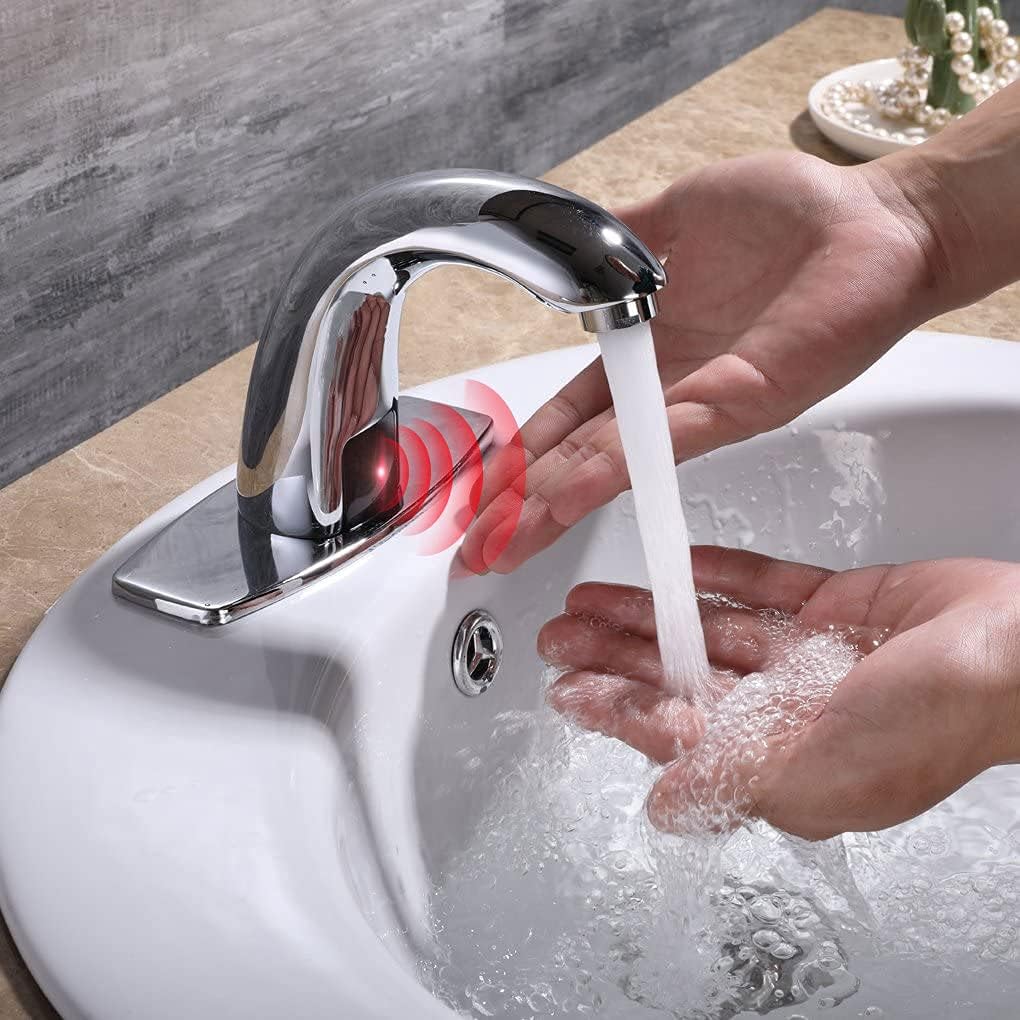
A touchless faucet is exactly what it sounds like: a faucet that turns on automatically when it detects your hands beneath the spout, then shuts off when you pull away — no handle, no knob, no contact. The “sensor” doing that work is almost always an infrared (IR) proximity sensor, the same basic technology used in automatic door openers and motion-activated lights, paired with a solenoid valve (an electrically controlled water valve that opens and closes in milliseconds). If you’re reading this because a parent’s arthritis is making standard handles painful, because toddlers in your house treat faucets like irrigation systems, or because you’re outfitting a small-business restroom for infection control, this guide is written for you. By the end, you’ll know which power supply option matches your traffic level, why that hose connection under the sink keeps dripping, and how to think about long-term parts availability before you commit to a unit.
| EDITOR'S PICKTouchless Bathroom Sink Faucet… | Mid-tierCharmingwater Touchless Bathroo… | Budget pickTouchless Bathroom Sink Faucet | |
|---|---|---|---|
| Power Source | Battery | — | Battery or Plug-in |
| Included Plates | — | ✓ | — |
| Control Box | — | — | ✓ |
| Mixer | — | — | ✓ |
| Finish | Chrome | Chrome | — |
| Price | $99.99 | $89.29 | $34.39 |
| See on Amazon → | See on Amazon → | See on Amazon → |
How the Sensor and Valve Actually Work — and Why It Matters for Your Decision
Most residential and light-commercial touchless faucets use a passive infrared (PIR) or active IR reflectance sensor mounted at the faucet’s base or spout tip. When your hands break the detection zone — typically 2–6 inches from the emitter — reflected IR light triggers a small control board that energizes the solenoid valve. Water flows. When hands leave, the valve de-energizes and closes. The whole cycle takes under half a second in well-reviewed units.
What owners consistently report across aggregated reviews is that sensor accuracy is generally reliable from day one — false activations are uncommon. The variable that actually differentiates brands is detection range, not false-trigger rate. A sensor optimized for a deep, farmhouse-style sink may over-activate on a shallow vanity basin. Check the manufacturer’s rated detection distance against your actual basin depth before buying.
The solenoid valve is the higher-wear component. It cycles every time the faucet activates, and in a high-traffic commercial restroom with 50–100 hand-wash events per day, that means 18,000–36,000 cycles per year. NSF International’s white paper on touchless fixtures in healthcare and food service environments notes that commercial-grade solenoid valves are typically rated for 500,000+ cycles, while residential-tier valves are often rated closer to 100,000–200,000. That gap is the single most important reason why a $35 residential unit is a poor fit for a food-service sink running six days a week.
Battery vs. Plug-In Power: Show the Math, Make the Call
Power supply choice is the decision that has the most downstream consequences, and it’s worth being explicit about the tradeoffs.
By the numbers (typical residential bathroom, ~15 activations/day):
| Power Type | Typical Battery Life | Annual Cost (batteries) | Install Complexity |
|---|---|---|---|
| 4× AA alkaline | 12–18 months | ~$4–$8 | No wiring, 15 min |
| 6× AA alkaline | 18–24 months | ~$6–$10 | No wiring, 15 min |
| AC adapter (plug-in) | Indefinite | ~$1–$2 (electricity) | Requires outlet under sink |
Sources: manufacturer spec sheets; battery cost estimates based on 2025–2026 US retail alkaline pricing.
For a home bathroom seeing light use, battery power is the pragmatic answer. There’s no electrician involvement, you can install on any sink with a standard supply-line setup, and at 15 activations per day, a quality alkaline set easily runs a year before needing attention. Owners consistently report that the low-battery warning (usually a blinking LED on the sensor housing) gives adequate advance notice — but “adequate” means days, not weeks, so don’t ignore it.
For a small-business restroom seeing 40+ activations per day — a two-seat salon, a four-table restaurant, a small medical office — the math shifts. At 50 activations per day, you’re looking at 18,250 annual cycles. AA alkalines in a 4-cell pack may only survive 6–9 months before voltage drops enough to cause slow valve response or incomplete shut-off (which presents as a slow drip that owners sometimes misattribute to a leak). The CDC’s guidance on hand hygiene supporting infrastructure specifically flags reliable water flow continuity as a compliance factor in food-handling environments — a fading battery undermines that. In this scenario, AC plug-in power with a transformer/adapter kit is the correct answer, even if it means running a switched outlet under the cabinet.
The decision rule: If your installation has an accessible outlet under the sink or you’re willing to have one added, choose plug-in for any commercial or semi-commercial use. Choose battery only if the install location genuinely lacks access to power and traffic is residential-light.
What happens when you forget to replace batteries? The solenoid valve requires a minimum voltage to open fully. As batteries discharge below threshold — typically around 3.6V for a 4×AA pack — the valve opens slowly or incompletely, reducing flow to a trickle. Most units will simply stop activating before reaching a state that causes valve damage, but that failure mode (faucet goes “dead” mid-day in a business restroom) is worse than a planned swap. Set a calendar reminder when you install; don’t rely solely on the LED indicator.
The Hose Connection Leak: Why It Keeps Happening and How to Fix It
This is the most actionable and under-discussed complaint across touchless faucet owner reviews, surfacing consistently across multiple brands and price tiers. Apartment Therapy’s coverage of touchless bathroom faucets has flagged installation frustration as a recurring theme, and a review pattern analysis across aggregated user feedback shows hose-connection leaks are nearly always attributable to one of three causes — not to defective hardware:
1. Kinked or cross-threaded supply line connection. The flexible braided supply lines included with most units are short and stiff. If the angle from the shutoff valve to the faucet inlet isn’t clean, the line wants to kink right at the compression fitting, creating a micro-gap that weeps under pressure. Fix: Use a third-party braided stainless supply line (12” or 16” depending on your cabinet depth) with a proper 3/8” compression-to-1/2” FIP adapter if needed.
2. Missing, displaced, or wrongly seated rubber washer. The vast majority of “leak at the fitting” complaints come down to the rubber flat washer inside the supply line’s female swivel nut being folded, missing from the factory bag, or seated crooked. This washer is what creates the watertight seal — the threads alone do not seal. Fix: Before threading any connection, visually confirm the washer is flat and centered in the recess. Finger-tighten first, confirm alignment, then use a basin wrench to snug — not over-torque — the fitting. Quarter-turn past hand-tight is usually sufficient for soft brass-to-rubber seats.
3. Over-tightening the faucet deck nut. Porcelain and cultured marble vanity tops crack or deform under excessive torque on the faucet mounting nut, which can also distort the faucet body and change the angle of the inlet fitting. Fix: Tighten the deck nut to the manufacturer’s specification. If none is listed, 15–20 ft-lbs is a reasonable ceiling for most residential units.
If you’ve addressed all three and still have a slow drip: pressurize the system, mark the fitting with a dry paper towel, wait 60 seconds, then inspect. A leak at the supply line end is almost always washer-related. A leak at the solenoid valve body suggests a cracked or over-pressured valve housing — rare but a warranty-return case.
Noise at Activation: What That Click or Buzz Means
Owners of several battery-powered units report an audible clicking or buzzing sound at activation, and the interpretation varies by sound type:
- Single clean click: Normal. This is the solenoid valve’s plunger moving to open position. It’s the same sound a sprinkler solenoid makes and is benign.
- Buzzing or chattering that persists while water flows: This typically indicates AC hum in a plug-in unit with a low-quality transformer, or — more commonly in battery units — low battery voltage causing the solenoid to oscillate between partial open and closed states. Replace batteries before assuming hardware failure.
- Buzzing that continues after water stops: Rare, but indicates a valve not fully closing. In battery units, replace batteries. In plug-in units, debris on the valve seat is the most common cause; turn off the supply line, disassemble the valve per the manufacturer’s guide, and flush.
One documented owner experience worth noting: reviewers of the WOODBRIDGE WF-V002 raised an activation noise complaint, and the brand’s customer service team responded with a proactive replacement unit — an unusually positive brand-response arc in a category where post-sale support is inconsistent. It signals that noise complaints in that line are taken seriously at the manufacturer level.
Replacement Solenoid Valves: The Aftermarket Gap
Here’s an honest gap in this product category: most manufacturers do not sell solenoid valves as standalone service parts. One reviewer of the Moen 8888 touchless kit specifically requested replacement valves sold separately and noted they weren’t available through standard channels. This is not unique to Moen — it’s a category-wide issue.
Your options when a solenoid valve fails out of warranty:
- Contact the manufacturer directly before assuming the part is unavailable. Some brands will ship valve assemblies as a “repair kit” even if they’re not listed in retail channels.
- Identify the valve’s specifications (operating pressure, coil voltage — usually 6VDC or 12VDC, and pipe thread size — usually 3/8” or 1/2” NPT) from the unit’s documentation, then source a compatible OEM-equivalent solenoid from an industrial supplier. Sensors Magazine’s analysis of IR sensor and solenoid integration in consumer plumbing notes that most residential-tier solenoids are commodity components produced by a small number of Chinese OEM manufacturers; a functional equivalent is usually findable by voltage and port spec.
- Treat the valve as the consumable, not the faucet. Budget $15–$30 for a replacement solenoid at the 3–5 year mark for heavy-use installs, rather than replacing the full faucet assembly.
Frequently Asked Questions
How do I stop my touchless faucet from leaking at the hose connections under the sink? Shut off the supply valve, disconnect the supply line, and visually confirm the rubber flat washer is present and flat inside the swivel nut. Reseat it if necessary, reconnect finger-tight, confirm alignment, then snug with a wrench — no more than a quarter-turn past hand-tight. If the included supply line is short or kinked, replace it with a longer braided stainless line.
Is battery power or AC plug-in power better for a touchless faucet in a high-traffic commercial bathroom? AC plug-in, unambiguously. At 40+ activations per day, batteries degrade fast enough to cause operational problems within six months. The marginal cost of adding an outlet under the sink is far less than repeated battery replacement and the downtime risk of a dead sensor mid-business-day.
What happens if I forget to replace the batteries in a battery-powered touchless faucet? Flow reduces to a trickle or stops entirely as voltage drops below the solenoid’s minimum operating threshold. Most units won’t damage the valve this way, but a non-functional faucet is the practical result. Set a recurring calendar reminder at install; don’t depend solely on the LED indicator.
Can I install a touchless faucet myself without a plumber if I have basic DIY skills? Yes, in almost all cases. The installation is mechanically equivalent to replacing a standard faucet: remove the old unit, feed the new faucet body through the deck hole, secure the mounting nut, connect supply lines, and restore water. The only scenario that warrants a plumber is if you’re adding a new outlet for a plug-in unit and aren’t comfortable with basic electrical work.
Why is my new touchless faucet making a loud clicking or buzzing noise when it activates? A single click is the solenoid opening — normal. Sustained buzzing during or after flow usually means low battery voltage causing the valve to chatter. Replace batteries first. If the noise persists on fresh batteries or a plug-in unit, inspect the solenoid valve seat for debris.
Where can I buy a replacement solenoid valve for my touchless faucet without replacing the whole unit? Start with the manufacturer’s customer service line — some brands supply valves as unlisted service parts. If that fails, identify the coil voltage (typically 6V or 12VDC) and port thread size from your manual, then search industrial plumbing suppliers or automation distributors for a compatible equivalent solenoid. It’s a commodity component in a non-commodity package.