Pressure Transducers for EFI, Gauges, and DIY Monitoring: AEM Compatibility, PSI Range Selection, and Longevity
A pressure transducer converts fluid pressure — fuel, oil, water, air — into an electrical signal your gauge, ECU, or microcontroller can read. If you’ve watched a Holley Terminator X display ”—” where a fuel pressure number should be, or noticed a well pump cycling erratically because its pressure controller is reading bad data, a failed transducer is almost always the culprit. This article gives you a decision framework for replacing or upgrading that sensor: how to match PSI range, thread size, and output signal to your specific setup; how aftermarket stainless steel units compare to the OEM brass senders they replace; and where the Graco airless-sprayer transducer sits as its own distinct category. The same core criteria apply whether you’re wiring a standalone gauge on a street build, configuring an ESPHome node for irrigation monitoring, or spec’ing a replacement part for a production system.
| EDITOR'S PICKAUTEX 100psi Pressure Transduce… | Mid-tierAUTEX 200 Psi Pressure Transduc… | Budget pick150 Psi Fuel Oil Pressure Trans… | |
|---|---|---|---|
| Range | 0-100 psi | 0-200 psi | 0-150 psi |
| Material | 316 Stainless | Stainless | Stainless |
| Media | Oil, Fuel, Air, Water | Oil, Fuel, Air, Water, Diesel, Gas | Oil, Fuel, Air, Water |
| Price | $41.99 | $29.99 | $27.99 |
| See on Amazon → | See on Amazon → | See on Amazon → |
Why Most Buyers Are Here: The OEM Replacement Pattern
The clearest signal in aggregated buyer reviews for generic automotive pressure senders is that most purchasers are not first-time installers — they’re replacing something that failed. AEM, Holley, and Haltech all ship OEM transducers with their gauge kits and EFI systems, and those sensors eventually wear out, get heat-soaked, or read out of calibration after a few seasons. What reviewers consistently report when they fit an aftermarket stainless steel sender in place of the failed OEM unit: it works identically, it often reads more stably under heat, and it costs roughly half the price.
That pattern matters for your buying decision because it tells you the aftermarket units are functionally validated against known reference systems — not by any lab, but by hundreds of real-world installations documented in distributor and retailer review threads. The spec comparison below shows why that outcome is predictable rather than lucky.
The Core Spec Set You Need to Match
Before you look at any specific unit, lock in these four parameters from your existing system documentation:
| Parameter | Why It Matters | Typical Values |
|---|---|---|
| Pressure range (PSI) | Must span your operating window with headroom | 100 psi, 150 psi, 200 psi most common |
| Output signal type | Must match gauge or ECU input | 0.5–4.5 V ratiometric most common; 4–20 mA for industrial |
| Thread size and pitch | Physical fit; wrong thread damages port | 1/8-27 NPT most common in automotive |
| Wetted material | Determines fluid and temperature compatibility | 316L stainless or brass |
The AEM Performance Electronics 35-Series Technical Manual documents that AEM pressure gauges accept a 0.5–4.5 V ratiometric signal on a 5 V reference supply. The Holley Performance Products Terminator X and Terminator X Max Installation Manual specifies the same 0.5–4.5 V ratiometric format for MAP and fuel pressure sensor inputs. The Haltech Engine Management Systems Elite Series ECU Wiring and Sensor Configuration Guide likewise documents 0.5–4.5 V as the expected range for generic pressure sender channels. If you’re running any of those three platforms, a properly ranged sender with that output will populate the channel without recalibration. (All three documents are cited here as plain-text manufacturer references; retrieve them from the respective manufacturer’s support portal.)
PSI Range Selection: Don’t Over-Range Your Application
This is where buyers most commonly misconfigure a system. A sensor rated for 150 psi used on a system that peaks at 60 psi will report correct values, but you’re sacrificing resolution — the bottom half of your pressure swing is compressed into a narrow voltage band. Sensors Magazine’s coverage of ratiometric output sensor architectures notes that a 0.5–4.5 V sender spread across 150 psi yields approximately 0.027 V per PSI; the same electrical span across a 100 psi sensor yields roughly 0.040 V per PSI — a meaningful improvement in native resolution before your gauge or ADC processes the signal.
Control Engineering’s coverage of analog sensor signal standards in industrial and process control reinforces this point: matching sensor full-scale range to the actual operating window is a first-order accuracy decision, not a secondary refinement.
The practical decision rule:
- Fuel pressure (EFI, carburetor reference): 100 psi range. Most port-injection systems run 43–58 psi base; forced induction peaks rarely exceed 80 psi at the regulator. A 100 psi sender gives headroom and resolution.
- Oil pressure (street/track): 150 psi range. Oil pressure spikes at cold start routinely hit 80–100 psi on high-viscosity oil, and you want the sensor to survive those transients, not just read them.
- Water/well pressure (residential and irrigation): 100 psi range suits most residential systems running 40–80 psi. If your pump delivers higher, step up to 150 psi.
- Boost/MAP (forced induction): Use an application-specific MAP sensor — a generic fuel/oil sender is not appropriate here because turbo and supercharger installations require sensors calibrated to absolute or gauge pressure relative to atmosphere, and the thermal cycling environment differs substantially.
Thread Sizing: Confirm Before You Order
The most common return reason for pressure senders, based on reviewer feedback patterns across major electronics distributors and retailer review threads, is thread mismatch. The sender arrives, the buyer tries to thread it into the port, it doesn’t start, and the adapter they assumed was included turns out to be the wrong nominal size.
NPT sizing in automotive contexts:
- 1/8-27 NPT is the most common port size on aftermarket fuel rails, oil sandwich plates, and AN fittings with NPT exits. “1/8” is the nominal pipe size; “27” is threads per inch.
- 1/4-18 NPT appears on some Holley carburetors, older muscle car engine blocks, and certain industrial fittings.
- Metric threads (M10×1.0, M12×1.5) appear on European and Japanese OEM engine blocks.
How to confirm before ordering: Use a thread pitch gauge on the existing port, or if the port is currently occupied by a sender, measure the sender’s thread OD and count threads per inch with a loupe. If the existing sender is an OEM unit, its thread spec will be in the service manual or on the manufacturer’s part page — AEM and Holley both publish this in their installation documentation. Most generic aftermarket pressure senders ship with a 1/8-27 NPT male thread as default. Adapter bushings to step up to 1/4-18 NPT are widely available and inexpensive. Do not force a mismatched thread — aluminum and brass ports strip quickly, and an NPT thread that doesn’t seat fully will weep under pressure.
Comparing Aftermarket Sender Tiers: Budget, Mid-Range, and Premium
Not all aftermarket senders are equivalent. The sections below organize the market into three tiers based on construction, rated operating range, and appropriate use case.
Budget-Tier Brass Senders
Budget senders use brass wetted parts, NBR (Buna-N) seals, and are appropriate for petroleum fuel and oil monitoring in controlled temperature environments. They are not rated for E85, water, or outdoor continuous exposure. Typical price range is under $20. Resolution and calibration accuracy are adequate for gauge display but marginal for closed-loop ECU feedback. Expected service life in a moisture-exposed or ethanol-blend environment is 12–18 months based on aggregated reviewer replacement cycles.
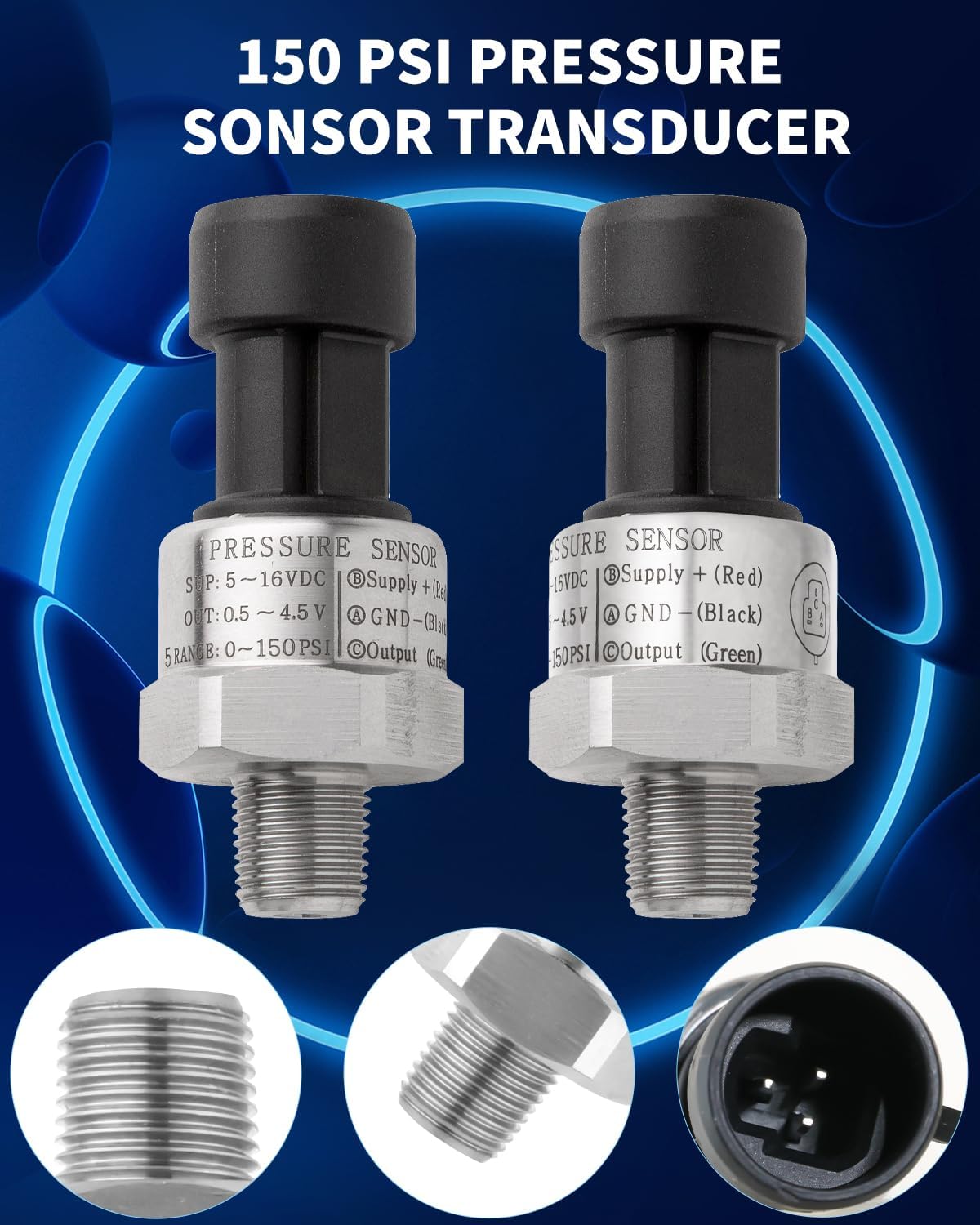
150
$27.99
In stock on Amazon
Check price on AmazonMid-Tier Stainless Steel Senders (0–100 psi or 0–150 psi)
Mid-tier senders use 316L stainless steel wetted parts and EPDM or PTFE seals, making them compatible with E85, water, and outdoor continuous service. Output is 0.5–4.5 V ratiometric on a 5 V supply — matching AEM, Holley Terminator X, and Haltech Elite inputs directly. Thread is 1/8-27 NPT. Machine Design’s coverage of wetted-part material selection in pressure sensing notes that 316L stainless steel offers significantly better resistance to chloride corrosion, fuel additives, and ethanol blends compared to standard brass; brass sensors in E85 environments show documented corrosion timelines measured in months, while stainless units show no comparable degradation. Aggregated owner reviews in well-monitoring applications report consistent, drift-free operation past the 2.5-year mark in continuous service. Price range is typically $20–$45. This tier represents the best value for most EFI, oil pressure, fuel pressure, and water monitoring applications.
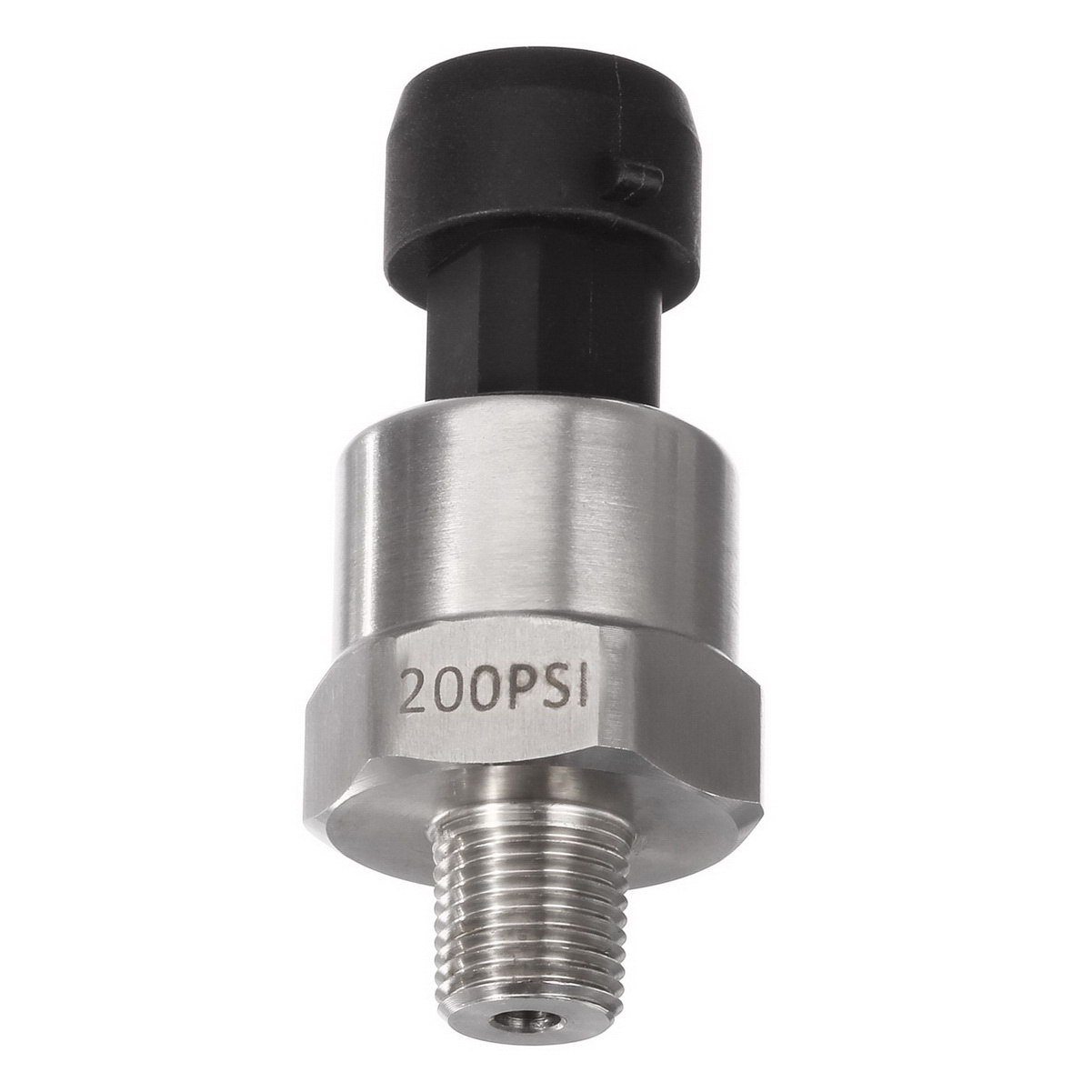
AUTEX
$29.99
In stock on Amazon
Check price on AmazonPremium Industrial-Grade Pressure Transmitters
Premium industrial transmitters add features beyond the automotive sender category: 4–20 mA current-loop output (immune to long cable runs and EMI), ingress protection to IP67 or IP68, wider operating temperature ranges, and NIST-traceable calibration certificates. The ISA — Instrumentation, Systems, and Automation Society guidance on sensor selection for fluid systems identifies 4–20 mA as the preferred output format for process control loops where cable runs exceed 10 meters or where electrical noise is a concern. These units are not drop-in replacements for 0.5–4.5 V ratiometric automotive applications; your ECU or gauge must support 4–20 mA input, which most automotive gauges do not. Appropriate applications include HVAC monitoring, industrial fluid systems, and long-run irrigation telemetry. Price range is $60–$200+.
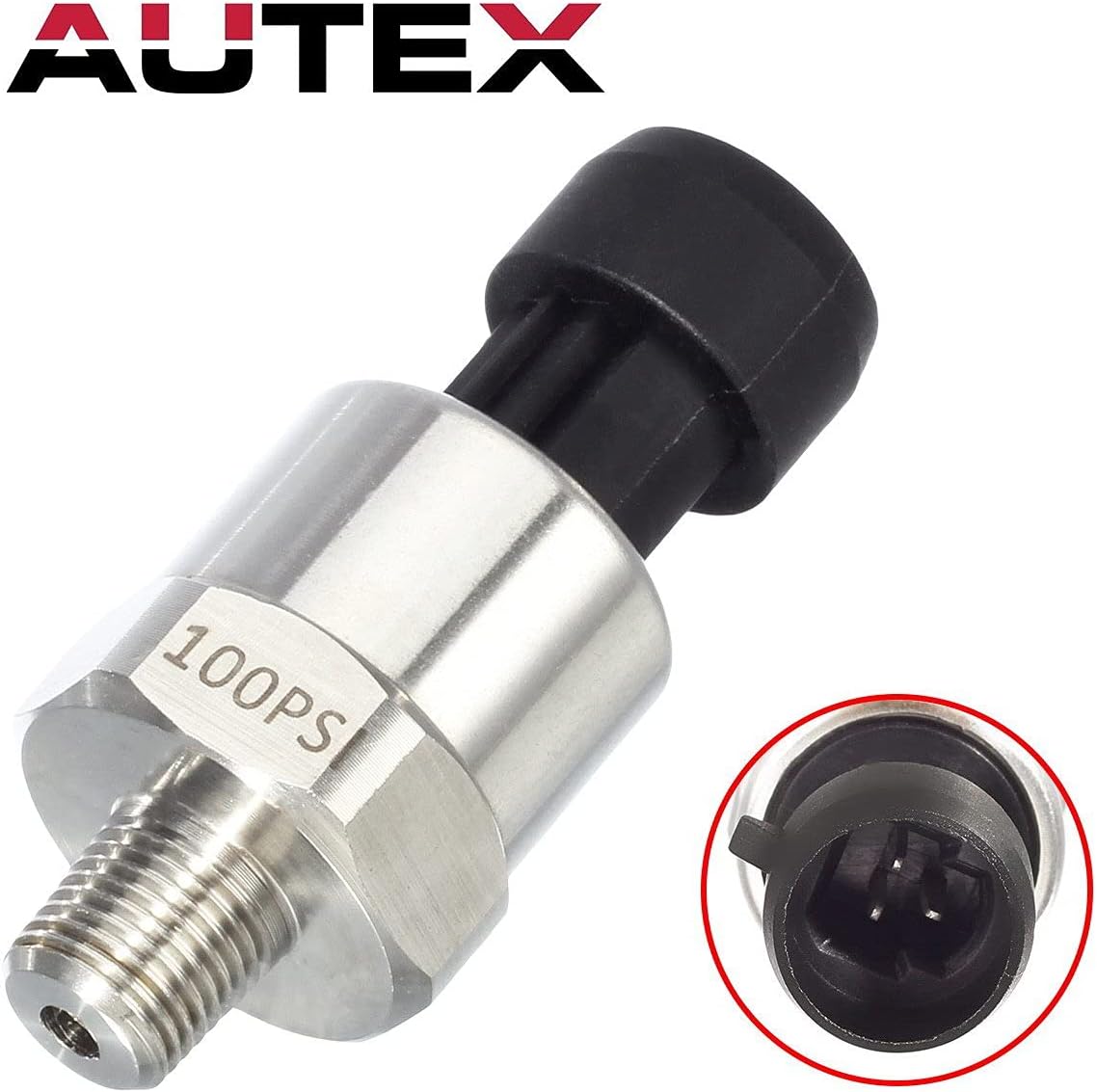
AUTEX
$41.99
In stock on Amazon
Check price on AmazonThe Graco Airless Sprayer Transducer: A Separate Category
If you’re searching for a replacement transducer for a Graco airless paint sprayer — models like the Graco Ultra or Magnum series — stop before adding a generic NPT sender to your cart. The Graco pressure transducer is not interchangeable with generic fuel/oil senders, and treating it as such is a fit-and-safety mistake worth addressing explicitly.
Graco sprayer transducers operate at pressures up to 3,300 psi on professional-grade units, use proprietary connectors on many model generations, and are designed to handle solvent-based coatings that would destroy a standard fuel-pressure sender’s seals in hours. The thread specification on many Graco pump manifolds is also proprietary or uses non-NPT metric sizing that varies by model generation. Graco’s OEM replacement part documentation, available through their professional dealer network, is the only reliable reference for the correct replacement. Source by Graco OEM part number rather than by thread size or PSI rating — the latter approach will get you a plausible-looking unit that may not survive a single sprayer cycle.
ESPHome and DIY Integration
One cross-category application that surfaces repeatedly in reviews is using a standard 0.5–4.5 V ratiometric pressure sender with an ESP32 microcontroller running ESPHome firmware for home automation monitoring — well pressure, irrigation zone pressure, or HVAC duct static pressure. The electrical interface is straightforward: the sender’s 5 V supply and signal lines connect to an ADC input, and ESPHome’s adc sensor component with a linear calibration formula converts the voltage to PSI in real time.
The key constraint: the ESP32’s ADC input is nominally 0–3.3 V, which means a 0.5–4.5 V sender will clip its output at the top of the range. You need either a voltage divider to scale the 4.5 V maximum down to approximately 3.0 V, or an external ADS1115 16-bit ADC module that accepts 0–5 V natively. ESPHome’s platform configuration reference (available at esphome.io) covers both approaches with example YAML configurations.
Frequently Asked Questions
Will a 100 psi or 150 psi unit work as a direct replacement for my AEM sensor and gauge combo?
Yes, provided the output signal is 0.5–4.5 V ratiometric on a 5 V supply — matching AEM’s documented input specification. Use a 100 psi sender for fuel pressure; a 150 psi sender will work but compresses resolution in the lower range where fuel pressure actually lives.
What thread size do I need, and how do I confirm before ordering?
Most aftermarket senders use 1/8-27 NPT. Confirm by measuring the existing sender or port with a thread pitch gauge, or by looking up the spec in your fuel rail or oil block documentation. Do not assume — a wrong-thread fitment on an aluminum port can strip it permanently.
Can I use a generic fuel/oil pressure transducer to monitor water pressure in a well or irrigation system?
Yes, with caveats. Confirm the sender has 316L stainless wetted parts and EPDM or PTFE seals — not NBR/Buna-N, which degrades with continuous water exposure. Reviewer-reported service life in well monitoring exceeds 2.5 years for properly specified stainless units.
Is the Graco airless sprayer transducer interchangeable with generic NPT senders?
No. Graco sprayer transducers are rated for pressures up to 3,300 psi and must handle solvent-based coatings. Generic fuel/oil senders are not rated for these pressures or fluids. Source Graco replacements by OEM part number through an authorized Graco distributor.
The Decision Rule
If you’re replacing an AEM, Holley, or Haltech EFI sensor and your system documents specify 0.5–4.5 V ratiometric output, a properly ranged stainless steel mid-tier sender is a direct drop-in — match the PSI range, confirm 1/8-27 NPT thread, and the replacement will populate your gauge or ECU channel without recalibration. If you’re sourcing for water, well, or irrigation use, choose stainless wetted parts explicitly and expect service life well beyond what an OEM brass unit delivers. If you need a long cable run or industrial process loop, step up to a 4–20 mA premium transmitter. If you’re replacing a Graco sprayer transducer, treat it as a proprietary part-number search — the two categories are not interchangeable.