If you’ve ever watched a motion flood light — a fixture that combines a broad-area LED lamp with a built-in PIR (passive infrared) sensor that detects body heat moving through its field of view — snap on when a raccoon walks across the driveway and stay on for hours after, you already understand the two problems this article is about: sensor quality and power delivery. Most buyers treat those as secondary concerns and focus entirely on wattage. That’s the wrong order of operations. A 70W fixture with a poorly aimed PIR gives you darkness when you need light, and a perfectly tuned sensor on a plug-in unit is worthless if your outdoor outlet is 40 feet from the corner of the garage you actually need to cover. This guide walks you through the real decision framework — plug-in versus hardwired, lumen output versus watt rating, and what verified long-term owner reports tell us about multi-year reliability — so you can make the right call before you’re standing on a ladder in November.
The Power Delivery Decision: Plug-In vs. Hardwired Is About Location, Not Convenience
This is the first fork in the decision tree, and most buyers get it backwards. The instinct is to ask “which is easier to install?” The right question is “where does the light actually need to be?”
Plug-in fixtures — units that terminate in a standard 120V grounded plug and draw power from an exterior GFCI outlet (Ground Fault Circuit Interrupter, the outlet type with the test/reset buttons required by code in wet locations) — have a hard constraint: you need a weatherproof exterior outlet within cord reach of the mounting point. That cord is typically 6 feet. If your outlet is at knee height on the garage wall and you want the fixture at the roofline 12 feet away, you have a problem that no product solves without an extension cord — which most manufacturers explicitly void the warranty for in outdoor applications. Where plug-in units shine is speed and reversibility. No permits, no junction boxes, no wire runs. For a covered porch, a rear deck with an existing outlet, or a rental property where a tenant needs functional lighting today, the plug-in format is legitimately the right answer.
Hardwired fixtures mount to a standard outdoor electrical box and connect directly to a circuit, typically with wire-nut junctions inside the box. The installation challenge reviewers consistently cite is not the wiring itself — running three wires to a wire nut takes five minutes. The actual labor is drilling through an exterior wall (usually 3.5 inches of framing plus siding) to reach an interior circuit, and depending on your jurisdiction, pulling a permit. If a box is already present where you want the light, hardwired installation is straightforward. If you’re running a new circuit or relocating a fixture to a blank wall, factor in that drilling time.
The long-run math: Hardwired fixtures typically carry longer manufacturer warranties (often 3–5 years versus 1–2 years for plug-in units) and are built to tighter weatherproofing standards because they’re marketed through professional installation channels. Plug-in units are often the same optical and sensor hardware in a package designed for retail velocity.
Lumen Output vs. Watt Rating: What the Numbers Actually Mean
Here’s the data point that consistently trips up buyers: wattage is a measure of energy consumption, not brightness. Lumens are the unit of visible light output. Because LED efficiency (lumens per watt) varies significantly between manufacturers and even between product lines from the same manufacturer, a 42W LED fixture can be brighter than a 70W unit from a different brand — or not.
The U.S. Department of Energy’s Outdoor Solid-State Lighting Technology FAQs (2024 edition) document that commercial-grade LED flood fixtures routinely achieve 120–160 lumens per watt, while budget fixtures often deliver 80–100 lumens per watt despite similar wattage claims. Sensors Magazine’s archived technical feature on PIR Motion Detection Fundamentals reinforces that sensor sensitivity is likewise a spec that varies independently of the fixture’s power draw — a critical point for buyers who assume higher wattage implies better-performing sensors.
Budget Pick: Plug-In Format, Mid-Lumen Range
For buyers who need lighting this week and have a GFCI outlet within cord reach, a plug-in unit in the 3,500–5,000 lumen range covers a standard driveway apron or rear deck without the installation overhead. Efficacy at this tier typically runs 80–100 lumens per watt. Warranty coverage is usually one year. The tradeoff is that cord length limits placement flexibility, and IP ratings at this tier often meet but do not exceed IP65.
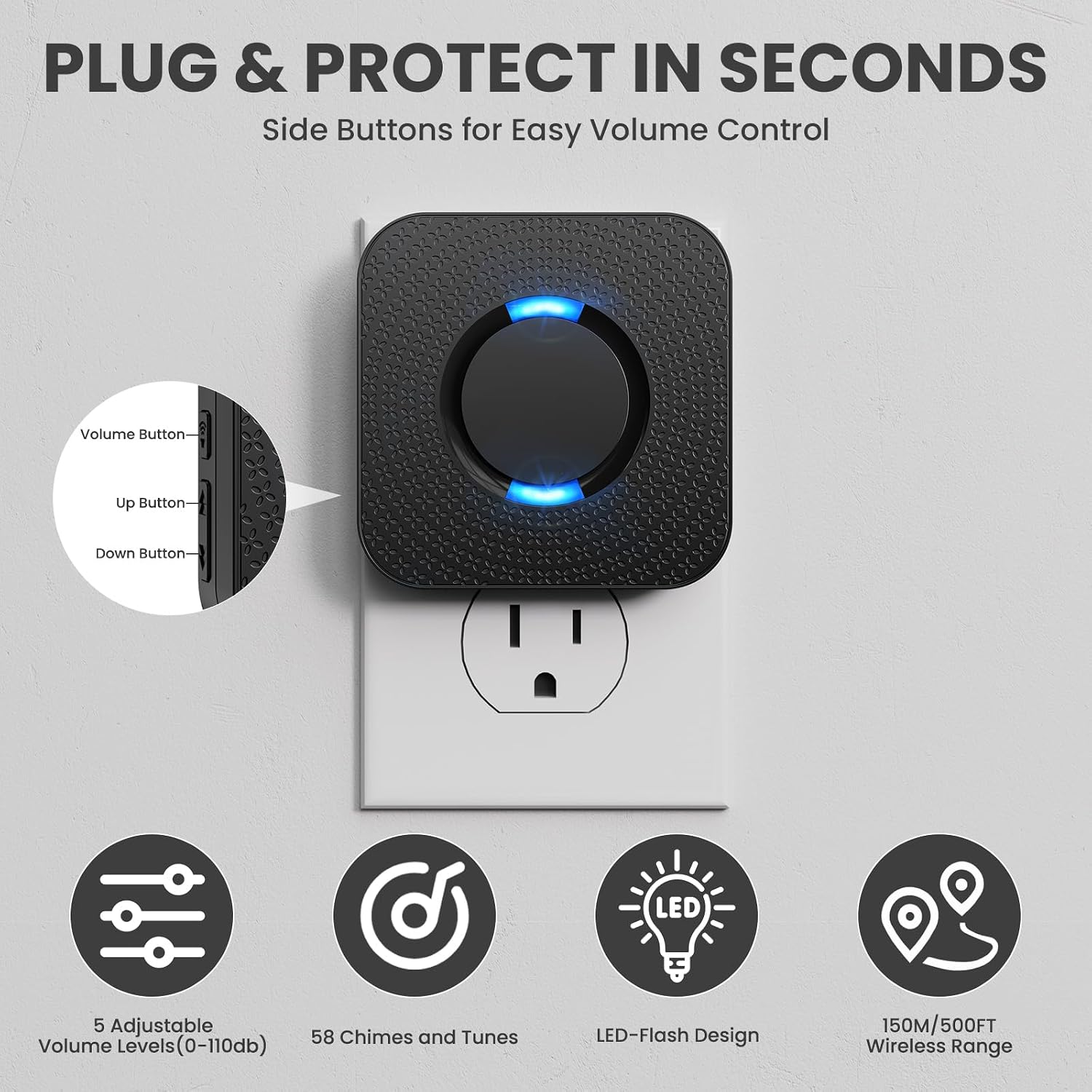
Wireless
$20.17
In stock on Amazon
Check price on AmazonMid-Tier Pick: Hardwired, Dual-Head, 6,000–7,000 Lumens
This is where most residential installations land. A 42W–55W hardwired dual-head fixture at 110–120 lumens per watt produces 4,600–6,600 lumens — enough to cover a two-car driveway, a backyard perimeter, or a commercial loading area entrance. The LEPOWER-TEC flagship at 42W produces approximately 4,200 lumens, which reviewer aggregates consistently praise as the fixture’s strongest attribute. The recurring qualification in long-term reviews is that the motion sensor performs adequately but is rated lower than the LED array itself — a useful signal for application matching. If your primary need is strong ambient illumination with motion detection as a secondary feature, this tier fits well. If reliable long-range detection is the primary function, weight that tradeoff carefully.
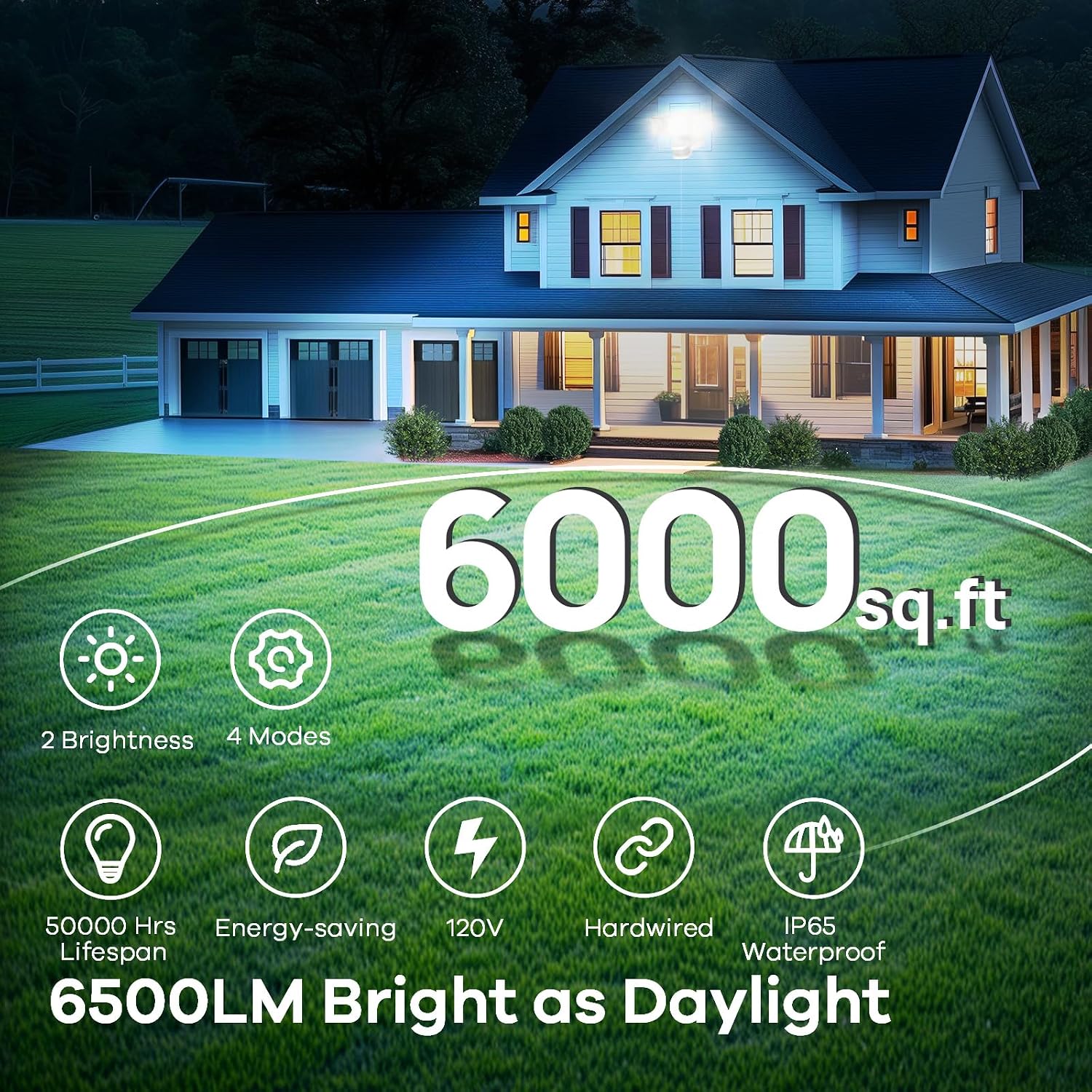
OREiN
$36.09
In stock on Amazon
Check price on AmazonPremium Pick: Hardwired, High-Lumen, Verified Multi-Year Runtime
At the top of the residential category, 70W hardwired fixtures producing 7,000+ lumens at roughly 100 lumens per watt cover large outdoor areas — multiple acres for property walks, commercial parking perimeters, or agricultural outbuildings. The Olafus 70W sits in this tier. Verified long-term owner reports document over two years of continuous outdoor operation lighting large areas for nightly use. That runtime matters because most consumer reviews are written within 30–90 days of purchase. A two-year outdoor report reflects real environmental stress — freeze/thaw cycles, UV exposure, sustained humidity — not initial impressions. OREiN’s high-lumen models (ranging 6,000–8,000 lumens depending on SKU) compete at this tier with efficacy in the 110–120 lumens-per-watt range; verify current SKU specs at point of purchase.
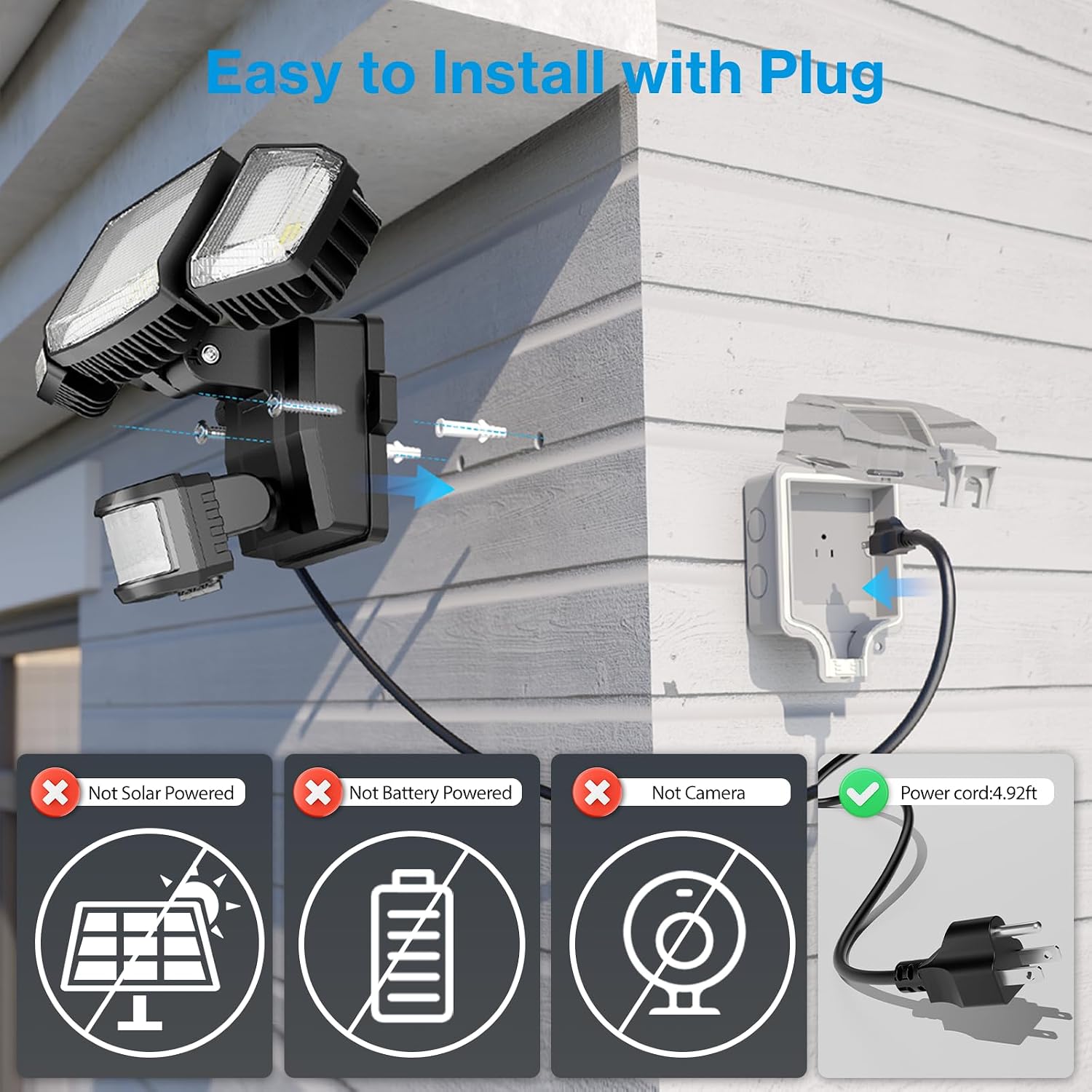
Olafus
$37.98
In stock on Amazon
Check price on AmazonLumen Output Reference
| Fixture | Rated Watts | Claimed Lumens | Implied Efficacy |
|---|---|---|---|
| Olafus 70W | 70W | 7,000 lm | ~100 lm/W |
| OREiN high-lumen model | varies by SKU | 6,000–8,000 lm | ~110–120 lm/W |
| LEPOWER-TEC flagship | 42W | 4,200 lm | ~100 lm/W |
Published spec data as of Q1 2026; verify current SKU specs at point of purchase.
PIR Sensor Performance: Why Coverage Varies and How to Fix It
A PIR sensor works by detecting the differential heat signature of a warm body — a person, a large animal — moving across segmented detection zones. It does not detect motion the way a radar or ultrasonic sensor does; it detects thermal contrast in motion. The Illuminating Engineering Society’s IES HB-10-21 Lighting Handbook (2021 edition) notes that PIR sensitivity is highly dependent on the angle of approach relative to detection zones: a target moving laterally across the sensor’s field of view is detected reliably, while a target moving directly toward the sensor presents less thermal contrast change and can fall below the trigger threshold.
Sensors Magazine’s PIR Motion Detection Fundamentals feature elaborates on this geometry: the detection lobes in a standard Fresnel-lens PIR array are widest in the plane perpendicular to the sensor’s boresight axis, which is why lateral movement produces the strongest signal. Radial approach — walking straight toward the sensor — minimizes zone-to-zone transition and degrades triggering reliability.
This explains the single most common complaint in outdoor flood light reviews: the light only triggers when you walk directly under it. This is almost never a defective sensor. It’s a mounting angle problem. The fixture is mounted directly above the path of travel, so approaching targets walk toward the sensor rather than across it.
OREiN fixtures illustrate this dynamic clearly. Owner reviews show a wide split — some report excellent wide-area coverage, while at least one documents the sensor only triggering when standing directly beneath the fixture. That’s more likely mounting angle variation between installations than unit-to-unit sensor quality variation.
Aiming checklist for dual-PIR fixtures:
- Mount at 8–12 feet height — lower mounting increases the angular sweep rate as a target approaches, improving triggering reliability.
- Orient both sensor heads so the primary detection axis is perpendicular to expected movement paths, not parallel to them.
- Use walk-test mode (a sensitivity dial on most units) to verify detection at your target range before finalizing mounting hardware.
- If covering a driveway entrance, mount to the side of the entrance, not above its center line.
IP Ratings, Weatherproofing, and Long-Term Reliability
IP65 is the current floor-level rating for outdoor flood lights in exposed installations. Under IEC 60529, Degrees of Protection Provided by Enclosures (Edition 2.2), IP65 means complete protection against dust ingress (the “6”) and protection against water jets from any direction (the “5”) — but not sustained submersion. For a fixture mounted under an open eave with overhang protection from direct rain, IP65 is more than adequate. For a fully exposed installation on an open post or fascia board with no overhang, you’re operating at the rating’s design envelope rather than inside it.
The practical durability difference between mounting positions is significant. An open-eave mounting reduces UV exposure, limits direct rain impact, and moderates thermal cycling — all of which extend LED driver and PIR sensor lifespan. A fully exposed mounting subjects the fixture to the full stress IP65 is designed to survive, not a comfortable margin above it. For permanently exposed installations in high-rainfall climates, sourcing an IP66 (higher-pressure water jet resistance) or IP67 (30-minute immersion at 1 meter depth) fixture adds meaningful margin, even though those ratings are less common in the consumer flood light category.
The Olafus 70W’s two-year owner-reported outdoor runtime is meaningful in this context — it confirms the IP rating is holding under real field conditions, not just laboratory test conditions.
Dusk-to-Dawn vs. Motion-Only: Using Both Features Strategically
Dusk-to-dawn mode uses an integrated photocell — a light-sensitive resistor that triggers the fixture when ambient light drops below a set threshold — to keep the fixture on continuously from sunset to sunrise. Motion-only mode uses the PIR sensor exclusively, leaving the fixture off until movement is detected. Most current high-lumen fixtures, including Olafus, OREiN, and LEPOWER-TEC models, offer a combined mode that uses the photocell as an activation gate and the PIR sensor to control brightness level or reset the on-timer within that window.
In combined mode, the fixture remains off during daylight (photocell override), activates at dusk, and can dim to a standby state during the dark period with motion triggering a full-brightness burst. Reviewers across all three product lines consistently cite this combined dusk-to-dawn-plus-motion configuration as a meaningful upgrade over simple motion-only operation — it creates layered security lighting that provides ambient coverage while still responding to discrete movement events.
Decision Rules: If X, Then Y
- If your outlet is within 6 feet of your mounting point and you need lighting this week: plug-in format. Prioritize lumen count; treat the motion sensor as a secondary spec.
- If you’re covering more than half an acre or need guaranteed long-range detection: hardwired installation is justified. The Olafus 70W’s two-year outdoor reliability record makes it the evidence-backed choice for high-demand runtime.
- If brightness is the primary requirement and sensor range is secondary: LEPOWER-TEC’s reviewer profile matches — strong lumen delivery, acceptable PIR performance.
- If you’re troubleshooting an existing fixture that only triggers at close range: reposition before replacing. Mounting angle is the first variable to eliminate.
Frequently Asked Questions
Why does my outdoor motion flood light only trigger when I walk directly under it instead of detecting from a distance?
Almost always a mounting angle issue, not a defective sensor. PIR sensors detect thermal contrast as a target moves across detection zones, not toward them. A fixture mounted directly above your path means you’re approaching radially, presenting minimal zone-to-zone contrast change. Remount the fixture to the side of the movement path so you cross the detection field rather than walk into it. Lowering mounting height to 8–10 feet also increases the angular sweep rate as you approach, improving triggering reliability.
What is the difference between dusk-to-dawn mode and motion-only mode, and can I use both at the same time?
Dusk-to-dawn mode uses a photocell to turn the fixture on at sunset and off at sunrise, regardless of movement. Motion-only mode uses the PIR sensor exclusively. Most current fixtures support a combined mode — the photocell acts as an activation gate, and the PIR sensor controls brightness level or on/off state within that window. Yes, you can use both simultaneously; this is the combined mode and it’s the standard configuration for security lighting.
Is a 70W LED flood light genuinely brighter than a 42W model, or do lumen ratings tell the real story?
Lumen ratings tell the real story. A 70W fixture at 100 lumens per watt produces 7,000 lumens. A 42W fixture at 100 lumens per watt produces 4,200 lumens. In this case the 70W unit is meaningfully brighter. But if the 42W unit achieves 130 lumens per watt, it produces 5,460 lumens — closing the gap significantly. Always compare published lumen specs, not wattage, when evaluating competing models.
How do I aim dual PIR sensors to eliminate blind spots at a driveway entrance?
Mount the fixture to the side of the entrance, not above its center line. Adjust each sensor head so its primary detection axis is perpendicular to vehicle or pedestrian movement — targets crossing the entrance will traverse both sensors’ lateral detection zones rather than approaching them head-on. Use walk-test mode to confirm triggering at 15–20 feet before finalizing mounting. Overlapping the two sensors’ zones slightly in the center of the coverage area eliminates the dead zone that single-sensor fixtures leave directly below the fixture.
Will an IP65-rated flood light survive fully exposed outdoor mounting versus under an eave?
IP65 is rated to survive water jets from any direction and is specified for full outdoor exposure. Under an open eave with overhang protection, you’re operating inside the rating’s protective envelope, which is favorable for long-term reliability. Fully exposed mounting is within IP65’s specification but at its design limit. Per IEC 60529, Edition 2.2, IP66 adds resistance to powerful water jets and IP67 adds 30-minute immersion tolerance at 1 meter depth — both ratings add useful margin for permanently exposed installations in high-rainfall environments.