A PIR motion sound player is exactly what it sounds like: a small device that detects a person walking nearby — using a passive infrared (PIR) sensor, which reads the heat signature your body emits — and automatically plays a pre-loaded audio clip. Think of the haunted-house skeleton that shrieks when you step past it, or the retail kiosk that starts a product demo the moment someone lingers at the display. If you’ve ever wondered how those are built without a professional AV crew, this guide is for you. We’ll walk through the tradeoffs between purpose-built PIR sound player modules and roll-your-own sensor-plus-microcontroller setups, name real product categories worth considering, and give you the decision rules to pick the right path for your specific install — whether that’s a one-off Halloween prop or a permanent lobby display running 12 hours a day.
How PIR-Triggered Audio Actually Works (And Where It Goes Wrong)
Every PIR sound player system has the same three-part chain: a PIR sensor detects motion → a logic layer interprets the signal → an audio playback module fires a clip. Where buyers get burned is almost always the middle link.
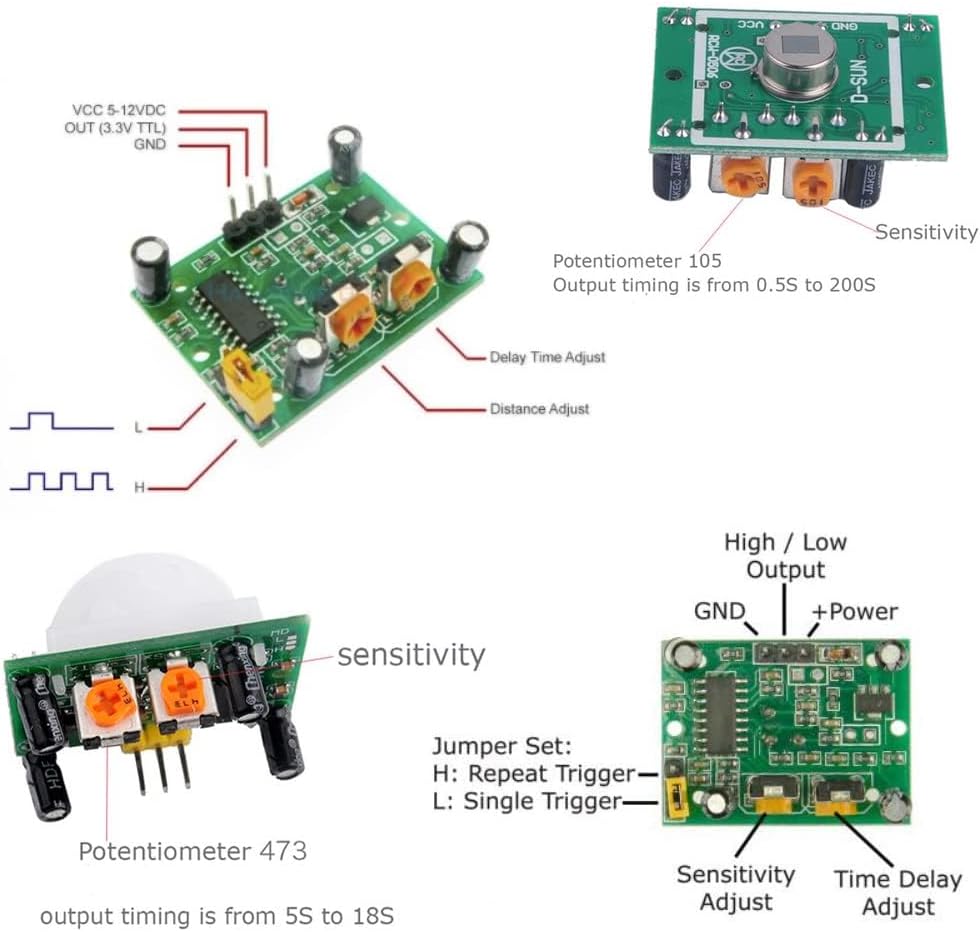
The two retriggering modes. Most PIR modules — including the widely distributed HC-SR501 — expose a small jumper or trim pot that selects between retriggerable (H mode) and non-retriggerable (L mode). In H mode, the output pin stays HIGH for as long as motion continues, which means a busy retail entrance will keep resetting the trigger and your audio clip may never complete. In L mode, the output pulses once and goes LOW after a fixed delay, letting the clip play through. Electronic Design’s article “Understanding Retriggering Modes in PIR Sensor Modules” (electronicdesign.com) explains this distinction in depth, and it is the most common configuration mistake cited by practitioners deploying these sensors in commercial settings.
Sensitivity and delay pots matter more than spec-sheet range. The HC-SR501 is rated to 7 meters detection range, but real-world useful range in a retail corridor — with reflective surfaces and HVAC airflow — is closer to 3–4 meters before false triggers become a problem. Turning down the sensitivity pot to roughly the 9 o’clock position and setting the time-delay pot to its minimum (approximately 3 seconds) is the standard starting configuration documented in the Adafruit Industries “PIR Motion Sensor Overview and Hookup Guide,” published on the Adafruit Learning System.
Voltage rail compatibility. Purpose-built PIR sound players typically run on 5V DC via USB or wall adapter. The HC-SR501 accepts 4.5–20V input, which gives flexibility, but its output signal is 3.3V logic — a detail to confirm before wiring it directly to a 5V-only sound board. Sensors Magazine’s application notes on passive infrared sensing (“Passive Infrared Sensing: Principles and Application Notes,” sensorsmag.com) identify this voltage mismatch as a recurring integration failure in mixed-voltage prototypes.
Purpose-Built PIR Sound Players vs. HC-SR501 + Microcontroller
This is the central decision in any PIR audio project, and the right answer depends on your use case, coding tolerance, and whether you need custom audio files.
Purpose-Built All-in-One PIR Sound Player Modules
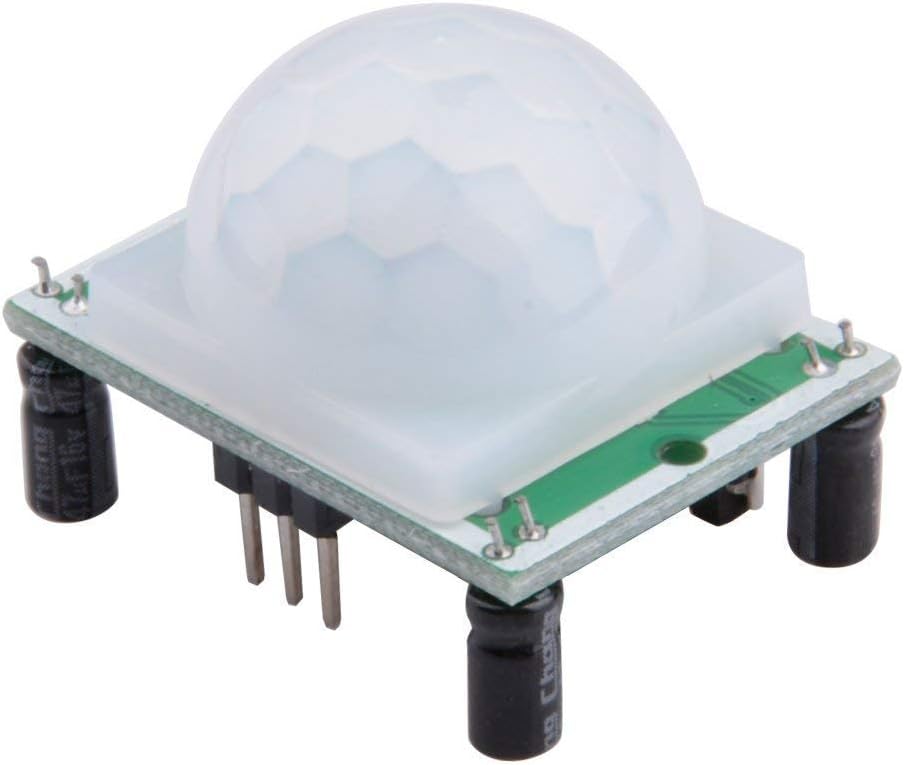
HiLetgo
$8.49
In stock on Amazon
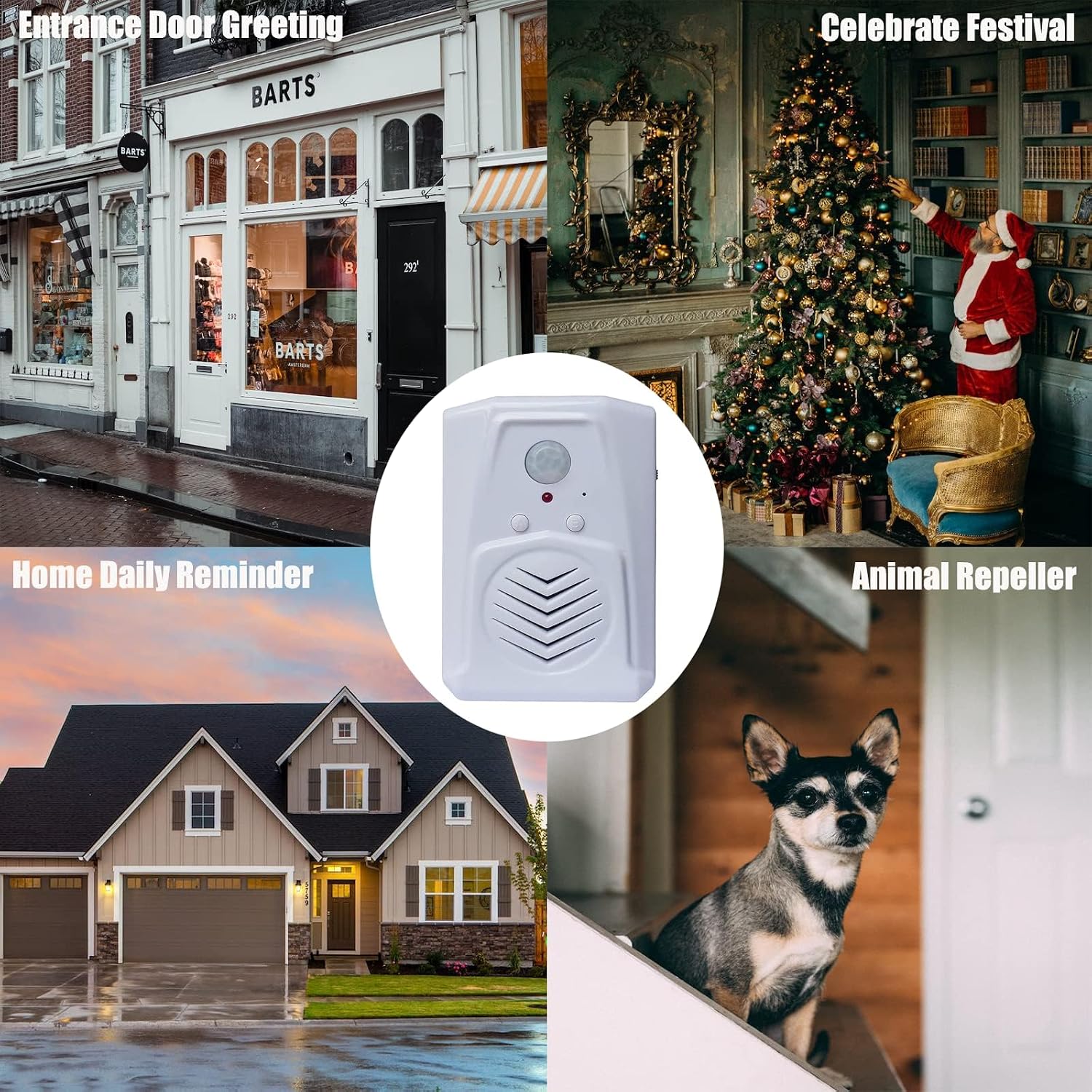
Check price on AmazonThe category of all-in-one PIR sound players — where the PIR sensor, MP3 decoder, amplifier, and speaker are integrated into a single housing — is the fastest path to a working display. You load an MP3 onto a microSD card, plug in power, and the unit handles everything else.
What practitioners consistently report about this category:
- Loudness surprises first-time buyers. Units deployed in public art installations and outdoor walkway activations frequently draw comments about volume exceeding expectations — which is genuinely useful when you need to cut through lobby ambient noise. Manufacturer-rated speaker output for units in this class typically runs 2–5W, adequate for a 10–15 foot radius in moderate ambient noise.
- Audio quality often exceeds expectations for the price point. Halloween and seasonal display builders note that playback fidelity is better than the compact form factor suggests, though housing construction on entry-level units tends to reflect the price — not built for permanent outdoor exposure without additional weatherproofing.
- Loading your own audio requires no code on most current units: format a microSD card as FAT32, rename your audio file according to the unit’s documentation (commonly
0001.mp3in the root directory, though naming conventions vary by chipset), and insert the card. The file plays on the next PIR trigger.
When to use a purpose-built unit: Single-location, seasonal, or temporary installs where you want to be operational in under 30 minutes. Halloween props, retail endcap demos, trade show booth activations, and museum interactives that don’t require custom integration logic are all strong fits.
When NOT to use a purpose-built unit: Multi-zone installs requiring centralized audio management, permanent outdoor fixtures where weatherproofing is non-negotiable, or any application requiring conditional logic (play clip A on first trigger, clip B on second trigger, and so on).
HC-SR501 + Dedicated MP3 Trigger Board (No-Microcontroller Path)
5pcs
$8.54
In stock on Amazon
Check price on AmazonThe HC-SR501 is one of the most widely distributed PIR modules available, and it is legitimately capable — but a critical point surfaces repeatedly among builders: the HC-SR501 requires additional components to play audio. Connecting an HC-SR501 directly to a speaker and expecting sound is a common first-timer mistake. The module outputs a logic signal; it does not decode or amplify audio.
The practical no-code path is: HC-SR501 → dedicated MP3 trigger board (the DFPlayer Mini being the most common) → small amplifier → speaker. Wired correctly, the DFPlayer Mini accepts a LOW-to-HIGH trigger on its I/O pins without any programming. This does require reading a wiring diagram, confirming voltage rail compatibility, and using either soldered connections or Dupont-style connectors.
This workflow becomes genuinely powerful when you need one PIR trigger to fire multiple outputs simultaneously — audio through the DFPlayer, plus a relay for a motor, plus a relay for a lighting effect. That multi-output capability is where the HC-SR501 path earns its place.
HC-SR501 path is worth it when: You need one trigger to fire multiple outputs, you are integrating into an existing Raspberry Pi or Arduino project, or you need granular control over sensitivity and timing that all-in-one units do not expose.
Integrated Weatherproof PIR Audio Units for Permanent Installations
PIR
$19.79
In stock on Amazon
Check price on AmazonFor permanent outdoor signage, entrance activations, or year-round retail fixtures, neither a bare purpose-built player nor a bare HC-SR501 assembly is sufficient without significant modification. Integrated weatherproof PIR audio units — designed for outdoor digital signage and commercial entrance applications — combine IP-rated enclosures, outdoor-rated speakers, and industrial-grade PIR sensors in a single assembly. These units carry a meaningfully higher price point than seasonal-use hardware, but they eliminate the engineering work of building a compliant outdoor enclosure yourself. Automation World’s coverage of sensor integration for interactive displays (“Sensor Integration for Interactive Displays,” automationworld.com) identifies weatherproofing and long-term trigger reliability as the two most underestimated requirements in permanent PIR-based exhibit builds.
Key Specs at a Glance
| Parameter | Purpose-Built PIR Player | HC-SR501 + DFPlayer Mini | Weatherproof Commercial Unit |
|---|---|---|---|
| Coding required | None | None (with trigger board) | None (configured at setup) |
| Audio file loading | microSD FAT32, drag-and-drop | Depends on paired board | Varies by manufacturer |
| Typical detection range | 3–5 m (built-in PIR) | 3–7 m (adjustable) | 5–10 m (industrial PIR) |
| Supply voltage | 5V DC (USB) | 4.5–20V DC | 12–24V DC (typically) |
| Output signal | N/A (self-contained) | 3.3V logic HIGH | N/A (self-contained) |
| Weatherproofing | None (user-added) | None (user-added) | IP44–IP65 (unit-rated) |
| Best for | Fast single-zone deploy | Multi-output or integrated builds | Permanent outdoor fixtures |
HiLetgo
$8.49
In stock on Amazon
Check price on Amazon5pcs
$8.54
In stock on Amazon
Check price on AmazonPIR
$19.79
In stock on Amazon
Check price on AmazonSensitivity Tuning: The Variable That Makes or Breaks the Install
Automation World’s “Sensor Integration for Interactive Displays” identifies sensitivity calibration as the most underestimated step in PIR-based exhibit builds — and practitioner experience consistently confirms this.
For retail entrances: The false-trigger problem is almost always sensitivity set too high combined with H (retriggerable) mode. The fix: set the PIR to L mode, reduce sensitivity to approximately 30–40% of maximum, and position the sensor at 1.5–2 m height aimed at chest level rather than sweeping the full doorway. The goal is detecting someone who has paused at your display, not everyone walking past in the corridor.
For outdoor seasonal displays: Thermal gradients from sunlight on pavement, HVAC exhaust vents, and passing vehicles all produce false triggers in outdoor environments. The time-delay pot is equally critical here — setting a minimum delay prevents a single ambient thermal event from retriggering the clip multiple times in rapid succession. Electronic Design’s “Understanding Retriggering Modes in PIR Sensor Modules” describes how even brief thermal pulses can satisfy the H-mode trigger threshold under direct-sun conditions.
For Halloween animatronics: You actually want the opposite configuration — maximum sensitivity, H mode — so the sensor fires as soon as someone approaches and stays HIGH to hold a relay closed for a motor or lamp effect. In this use case, the retriggering behavior that causes problems at a retail entrance becomes a desirable feature.
Weatherproofing a PIR Sound Player for Outdoor Use
Neither purpose-built PIR players nor bare HC-SR501 modules carry a meaningful IP rating out of the box. For any outdoor seasonal deployment, three practical options exist:
-
Project enclosure with a PIR-transparent window. Standard ABS project boxes seal the electronics; the PIR dome needs a line-of-sight opening, which you can cover with a thin sheet of HDPE or LDPE (both are largely transparent to the 8–14 µm infrared wavelengths PIR sensors read). Drill the opening slightly smaller than the dome and seat it with a rubber grommet.
-
Conformal coating the PCB. A single pass of acrylic conformal coat on the PCB protects against condensation and light moisture. This does not make the unit waterproof — it handles dew and light rain splash, buying weeks rather than a full outdoor season.
-
Pre-built weatherproof PIR housings. Industrial PIR housings rated IP44–IP55 are available in the $15–$40 range and accept standard PIR modules. Pair with an outdoor-rated speaker in a separate IP65 enclosure with sealed cable pass-throughs. For anything expected to survive a full outdoor season, this is the honest recommendation.
Frequently Asked Questions
How do I load my own MP3 files onto a PIR sound player without coding?
Format a microSD card (8 GB or smaller is recommended for compatibility) as FAT32, rename your audio file to 0001.mp3 or per your unit’s documentation — naming conventions vary by chipset — and copy it to the root directory. Insert the card, power the unit, and it will play on the next PIR trigger. No software or drivers required.
How loud is a typical all-in-one PIR sound player, and is it adequate for outdoor use? Units in this class output 2–5W through an integrated speaker. Practitioners deploying them for outdoor walkway activations and public-space installations consistently report the volume is louder than the compact form factor suggests, and functional for open-air use within roughly 10–15 feet of the speaker. For larger outdoor areas or high-ambient-noise environments, connecting a powered external speaker via the unit’s aux or line output is the reliable path.
Can I use an HC-SR501 to trigger a sound without an Arduino or microcontroller? Yes, but not with the HC-SR501 alone. You need a trigger-compatible MP3 playback board — the DFPlayer Mini is the most common choice. The HC-SR501’s output pin connects to the DFPlayer’s I/O trigger input; when the PIR fires, the DFPlayer plays the loaded file. No code is required if wired correctly. Critical detail: confirm the HC-SR501’s 3.3V output signal is compatible with your playback board’s trigger input threshold before wiring.
Why does my PIR sensor keep retriggering the sound repeatedly instead of playing once? You are almost certainly in H (retriggerable) mode. Locate the small jumper on the HC-SR501 board and move it from H to L to enable single-trigger mode. Also reduce the time-delay pot to its minimum so the output pulse is short. In busy environments, additionally lower sensitivity to prevent ambient thermal sources — HVAC exhaust, sunlight on flooring — from holding the trigger HIGH.
What is the best way to weatherproof a PIR sound player for an outdoor seasonal display? Mount electronics in a sealed ABS or polycarbonate project enclosure with a PIR-transparent HDPE or LDPE window cutout. Apply acrylic conformal coat to the PCB for condensation resistance. Use an outdoor-rated speaker in a separate sealed enclosure with sealed cable pass-throughs. For multi-week outdoor seasons, a pre-built IP44+ PIR housing paired with an IP65 electronics enclosure is the more durable and reliable approach.
How do I reduce false triggers in a busy retail entrance? Switch the PIR to L (non-retriggerable) mode, reduce sensitivity to roughly 30–40% of maximum, and aim the sensor at chest height rather than sweeping the full entrance width. Position it to detect dwell — someone standing at the display — rather than transit. The minimum dead-time most PIR modules enforce after a trigger (typically 2–3 seconds) also helps prevent a single pedestrian pass from firing the clip multiple times.
The Decision Rule
If you need audio playing within 30 minutes and have one zone: A purpose-built all-in-one PIR sound player is the right tool. Load your MP3, done.
If you need one motion event to trigger audio plus a relay for a motor or lighting effect: Use an HC-SR501 paired with a DFPlayer Mini and a relay module. Budget an hour for wiring and voltage-rail verification.
If you are building a permanent outdoor fixture: Neither bare option is sufficient as-is. Budget for an IP44+ enclosure, conformal coat, and an outdoor-rated speaker — or source an integrated weatherproof PIR audio unit designed for commercial outdoor use from the outset.
If false triggers are your current problem: Set L mode, reduce sensitivity, and adjust aim before purchasing any new hardware. In the overwhelming majority of field reports, persistent false triggering is a configuration issue, not a hardware failure.