Plug-In and Hardwired Outdoor Motion Flood Lights: Lumen Output, Dual-Head Coverage, and Two-Year Durability
A motion-activated flood light — a weatherproof LED fixture that switches on automatically when its passive infrared sensor (PIR) detects body heat crossing its field of view — is one of the highest-return security and convenience upgrades you can make to a building exterior. Dual-head units now push 7,000–10,000 lumens from a wall-mount that costs under $60, and PIR detection zones have grown wide enough to cover a two-car driveway in a single field of view. But “capable” and “reliable for two years” are not the same claim, and the owner-review record across retail platforms tells a more nuanced story than any spec sheet. If you have a driveway, garage corner, or loading-dock perimeter to light and you are deciding between plug-in and hardwired options right now, this comparison gives you the decision frame you need.
Plug-In vs. Hardwired: The Real Tradeoff Is Installation Risk, Not Performance
The plug-in/hardwired distinction matters less for lumen output than it does for where you can realistically mount the fixture and what happens when the driver eventually fails.
Plug-in units (typically 120V with a standard NEMA 5-15 plug) let you position the fixture anywhere within cord reach of a GFCI-protected exterior outlet — no electrician, no permit in most jurisdictions. The tradeoff is cord management and the aesthetic reality of a cable running along siding. For residential garages and rental properties where a tenant or property manager needs to swap a failed unit without tools, plug-in wins on total cost of ownership.
Hardwired units connect directly to a junction box and are generally required for commercial exteriors, HOA-governed properties, and any installation where the cord would create a trip hazard or a code violation. They are also the default for dual-head fixtures rated above 60W, where a plug-in cable would need to be heavier gauge than a standard extension cord can safely provide.
The practical decision rule: if you have a GFCI outlet within 8 feet of the mount point, plug-in is appropriate for residential use. For anything commercial, multi-fixture, or junction-box-adjacent, hardwire and be done with it.
Lumen Output: What the Numbers Actually Mean at Ground Level
Manufacturers quote lumens — total light emitted by the fixture — rather than lux, which measures lumens per square meter at a target surface. That choice makes comparison-shopping feel cleaner than it is. A fixture rated at 7,000 lumens can illuminate a two-car driveway brilliantly or barely wash a 20-foot circle, depending entirely on the beam angle of each head.
The Illuminating Engineering Society publishes IES LM-79-19: Approved Method for Optical and Electrical Measurements of Solid-State Lighting Products as the reference method for measuring actual delivered lumens from an LED fixture. Most residential-grade fixtures are not independently tested to this standard. Treat manufacturer lumen figures as ±15–20% estimates unless a third-party photometric report is cited in the product documentation.
Dual-head motion flood light typical specs — 2025 market:
| Spec | Entry tier ($25–$45) | Mid tier ($45–$70) |
|---|---|---|
| Rated lumens (total) | 3,000–5,000 lm | 6,000–10,000 lm |
| PIR detection angle | 120°–140° | 150°–180° |
| Detection range | 30–40 ft | 40–70 ft |
| IP rating | IP44–IP54 | IP65 |
| Rated LED life | 30,000 hr | 50,000 hr |
For a concrete reference point: 5,000 lumens from a dual-head fixture with 120° beam angles will cover a standard two-car driveway (roughly 20 × 20 ft) to approximately 10–15 lux at ground level — enough to identify a face at 15 feet but not enough for license-plate-quality resolution at 40 feet. Push to 7,000–9,000 lumens with 150°+ heads and you can sweep both the driveway and the adjacent side yard simultaneously. That coverage geometry is achievable, but only if both heads are independently adjustable and properly aimed after installation.
Three Fixtures Worth Understanding in This Market
Olafus: The Two-Year Durability Data Point
Most product reviews age out within 90 days of purchase. A verified purchaser who bought an Olafus dual-head motion flood light in March 2023 and returned to update their Amazon review in April 2025 — describing it as one of the best inexpensive investments they had ever made — represents the kind of longitudinal owner signal that carries real weight. That span covers two Pacific Northwest winters: freeze-thaw cycles, sustained rain, and UV exposure. The unit was reported fully functional as originally purchased.
Owners across the aggregated review record consistently note that sensitivity dial calibration takes a full week of trial-and-error, particularly tuning the detection zone to exclude raccoons or wind-blown shrubs. The sensitivity pot — a small adjustable resistor setting the PIR threshold — is recessed behind a pinhole cover, appropriate for outdoor use but requiring a screwdriver and a dusk-time calibration session. Plan for that before declaring the install complete.
The Olafus line spans plug-in and hardwired variants across 5,000–10,000 lumen output tiers. Based on the aggregated two-year review record, the mid-range hardwired model represents the standout value in this comparison cluster.
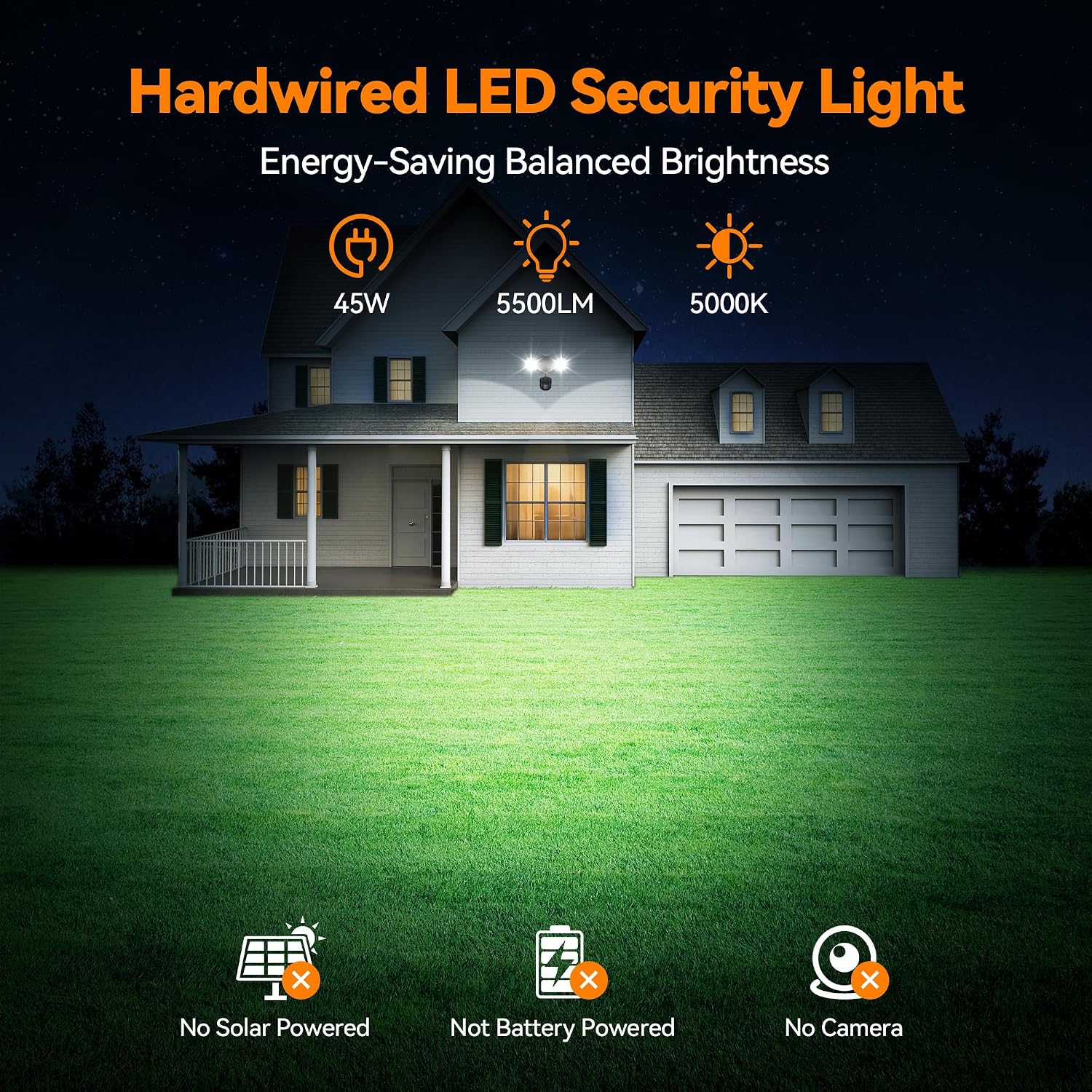
45W
$28.87
In stock on Amazon
Check price on AmazonOREiN: A Repeating Standby-Brightness Problem
The OREiN motion flood light hits competitive lumen numbers and its PIR range is well-regarded in owner feedback, but a repeating complaint across verified purchaser reviews is specific enough to belong in any honest comparison: the standby-mode (always-on dim) brightness level is high enough to be objectionable to neighbors. Most dual-head flood lights offer a dim standby mode — a low-level glow for general wayfinding — but multiple OREiN owners report the standby level sits closer to 20–25% of full output rather than the 5–10% typical of this product category. In a dense suburban or multifamily setting, that becomes a neighbor-relations issue within two weeks of installation.
If standby brightness matters to your application — HOA properties, townhouse exteriors, or commercial buildings with residential adjacency — verify this characteristic in current reviews before purchasing. As of spring 2025, the pattern in owner feedback was consistent enough to classify it as a design characteristic rather than a quality-control outlier.
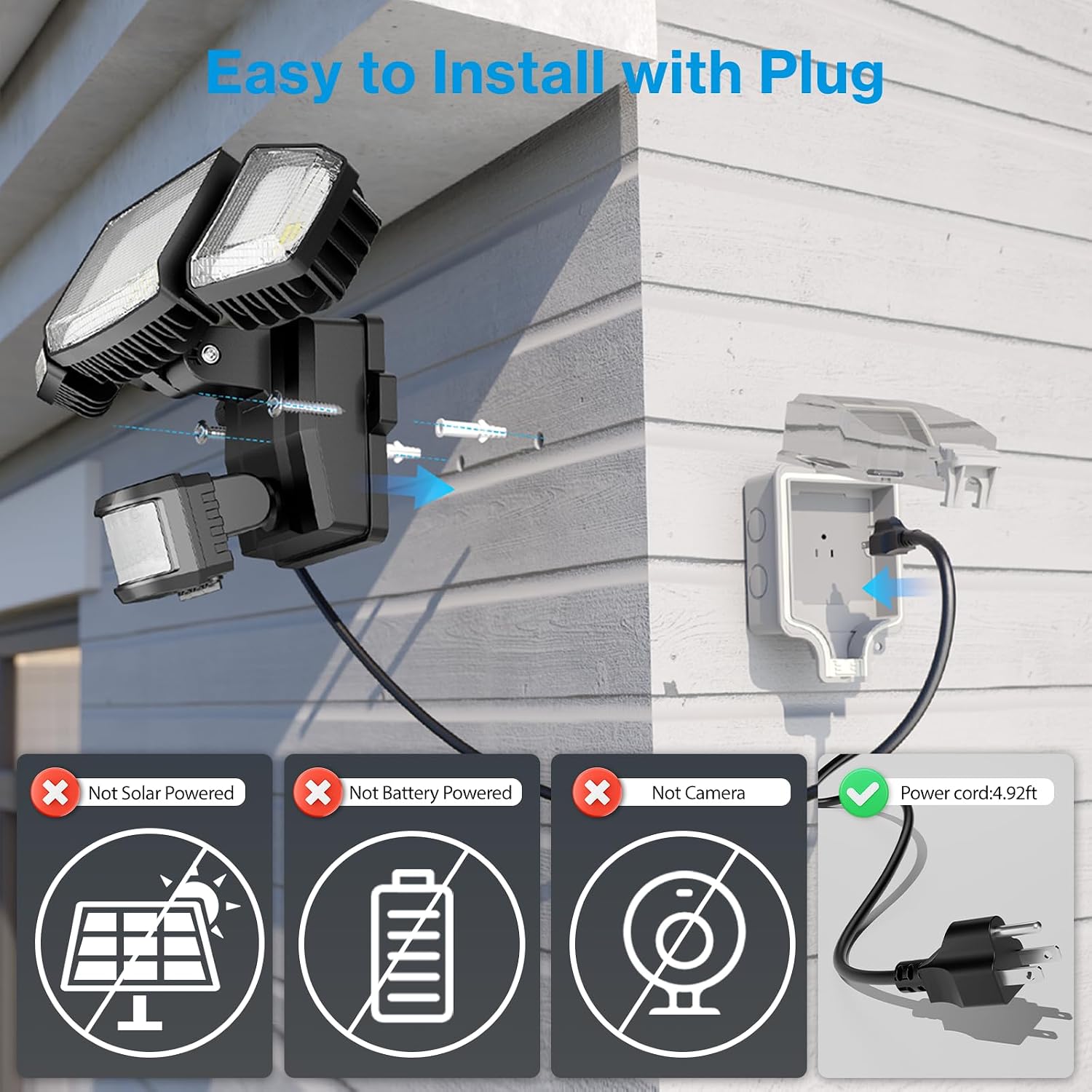
Olafus
$37.98
In stock on Amazon
Check price on AmazonLEPOWER-TEC: The ‘Zero Blind Spots’ Claim vs. Coverage Geometry
LEPOWER-TEC markets several of its dual-head fixtures with “zero blind spots” coverage language. The actual geometry: a 180° PIR detection angle on a single sensor will have a dead zone directly below the fixture (within roughly 6 feet of the mounting point) and at the extreme lateral edges of the detection cone when a target moves parallel to the sensor axis rather than crossing it. This is not a flaw unique to LEPOWER-TEC — it is a physical characteristic of passive infrared sensing. PIR detectors trigger on motion that crosses thermal boundaries; a person walking directly toward the sensor along the detection axis may not trigger it reliably until they are quite close.
“Zero blind spots” is marketing language for “wide coverage angle.” Whether that coverage geometry matches your installation depends on where you mount the fixture relative to the paths you want to monitor. For corner-mount installations where traffic crosses the detection field obliquely, 180° PIR fixtures perform as claimed. For straight-on approaches along a long narrow driveway aimed directly at the sensor, a sensitivity boost and lower mounting height will close the gap.
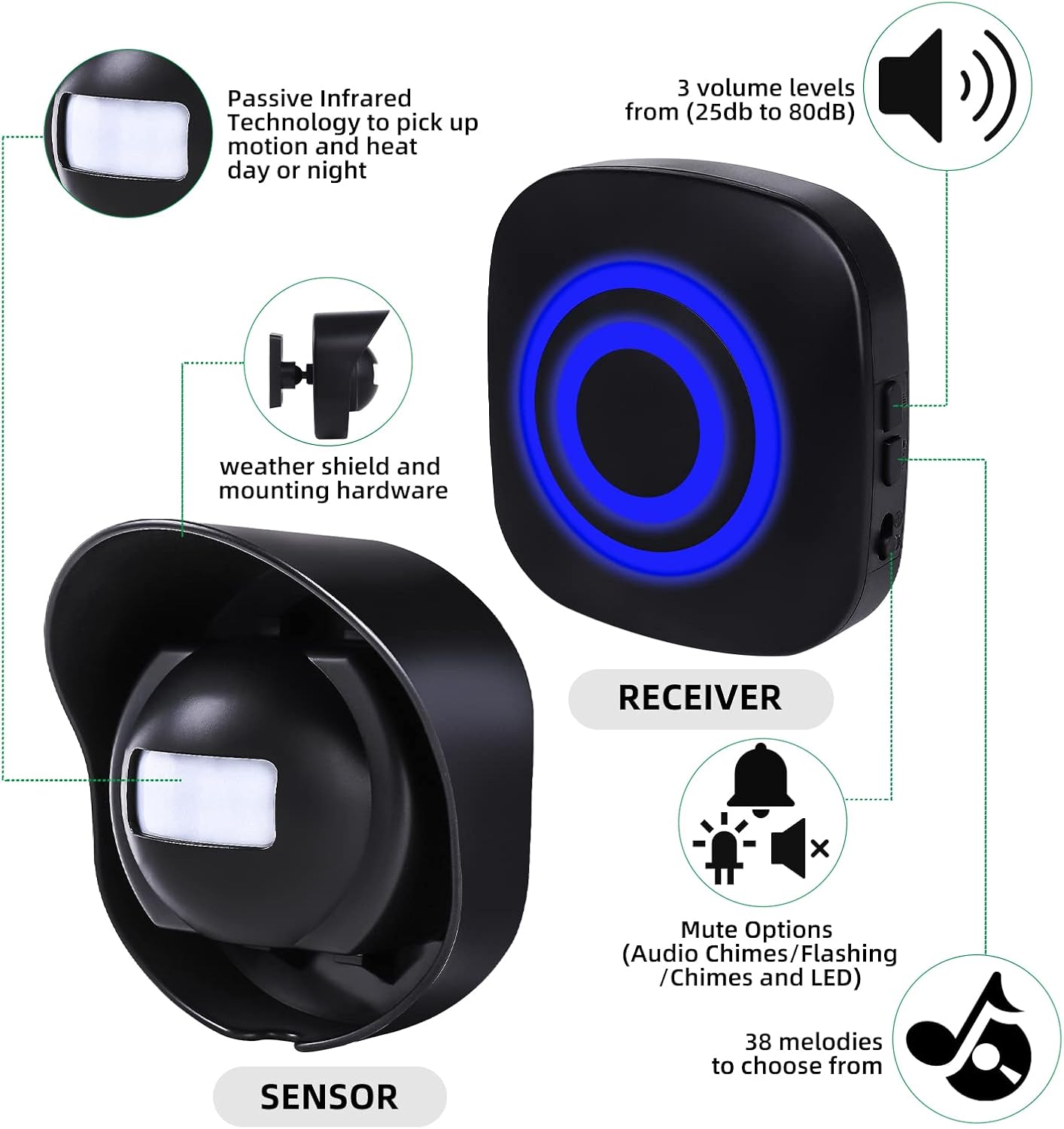
328ft
$39.99
In stock on Amazon
Check price on AmazonIP65 Weatherproofing: What the Rating Covers and What It Does Not
IP65 is the minimum rating you should accept for any permanently mounted exterior fixture. The International Electrotechnical Commission’s standard IEC 60529, Degrees of Protection Provided by Enclosures (IP Code), defines IP65 as complete protection against dust ingress (the “6”) and protection against water projected from a nozzle in any direction (the “5”). What it does not cover: submersion, driving rain at extreme angles against a horizontally mounted fixture, and seal fatigue over repeated freeze-thaw cycles spanning multiple years.
Heavy snow and ice do not directly threaten an IP65-rated fixture through water ingress — the seals handle precipitation-level water exposure. The durability risk in freeze-thaw environments is mechanical: ice expansion stressing the adjustment joints of dual-head fixtures, and UV degradation of polycarbonate lenses over years of thermal cycling. The Olafus two-year review data suggests IP65-rated residential fixtures can handle this well when properly installed.
The LED junction itself typically outlasts the driver electronics and PIR sensor by a significant margin. The U.S. Department of Energy’s Office of Energy Efficiency and Renewable Energy documents in its technical report Lifetime of White LEDs that LED junction failure at rated hours is far less common than driver circuit or sensor module failure — components that typically reach end-of-life in the 3–7 year range for residential-grade fixtures, well before the LED array itself degrades meaningfully.
Dual-Head Mount Orientation: The Installation Gotcha Nobody Puts in the Instructions
At least one verified purchaser of a dual-head flood light documented having to open the fixture housing and physically flip the internal arm brackets to achieve horizontal mounting — the as-shipped bracket orientation only allowed vertical adjustment, pushing both heads downward when the fixture was wall-mounted in the standard horizontal position. This is not a universal problem, but it appears often enough in the under-$60 segment to belong on your pre-installation checklist.
Before you commit to a mounting location: confirm that the arm brackets on your specific unit allow the head rotation and tilt range your installation geometry requires. Check the product listing’s owner photo gallery — real installer photos showing horizontal mounting are more reliable than the product rendering. If you are ordering for a commercial retrofit where a return is inconvenient, request the adjustment-range specification from the manufacturer or distributor before the order ships.
Frequently Asked Questions
How much area will a 7,000-lumen motion flood light actually illuminate? At 7,000 lumens with two independently adjustable heads at 150°+ each, you can cover a two-car driveway (approximately 400 sq ft) and a similar-sized side yard, provided both heads are aimed to overlap in the center gap. Security-recognition illumination requires roughly 10 lux at the target surface. A 40-foot deep lot with the fixture mounted at 10 feet elevation will see meaningful light falloff at the far end — a product of inverse-square light physics, not a product defect.
What is the difference between dusk-to-dawn mode and motion-only mode? Dusk-to-dawn mode keeps the fixture on continuously from sunset to sunrise at full output. Motion-only mode keeps the fixture dark until the PIR triggers, then runs the light for a programmed duration (typically 5–120 seconds, adjustable). For energy cost and neighbor relations, motion-only is the default recommendation. Dusk-to-dawn suits loading docks, parking areas, and any location requiring consistent baseline illumination regardless of activity level.
How do I stop my motion flood light from triggering on small animals or wind-blown branches? Set the sensitivity dial to its lowest position first, then increase incrementally over several nights. Reducing detection range also narrows the angular sweep that picks up low-to-ground targets. Mounting height matters: at 9–12 feet, the PIR cone’s lower edge rises above the 12–18 inch range where cats and raccoons typically travel. Some fixtures include a pet-immunity mode filtering thermal signatures below a set mass threshold — check the spec sheet for your unit.
Does IP65 waterproofing mean the light can handle heavy snow and ice? Yes for water ingress from snow melt and freezing rain. IEC 60529, published by the International Electrotechnical Commission, defines IP65 as covering directional water projection, which encompasses most precipitation scenarios. The durability risk in freeze-thaw environments is seal fatigue over 3–5 years and mechanical stress on adjustment joints — not immediate water intrusion.
How long do LED motion flood lights actually last outdoors before the driver or sensor fails? The LED array is typically rated for 30,000–50,000 hours and is the most durable component in the assembly. The driver and PIR sensor module are the more likely failure points, with typical service life in the 3–7 year range for residential-grade fixtures — consistent with findings documented in Lifetime of White LEDs, a technical report from the U.S. Department of Energy’s Office of Energy Efficiency and Renewable Energy. Two-year owner reviews showing fully functional units, such as the Olafus data point in this comparison, are a positive indicator but not a guarantee of full rated life.
Decision Rule
If your priority is proven two-year durability at the lowest price point: the Olafus mid-range hardwired unit has the most credible longitudinal review record in this segment. Budget a full calibration session after installation.
If standby-mode brightness will affect neighbors or HOA compliance: research current OREiN owner reviews specifically for standby output level before purchasing, and prioritize fixtures with a documented low-standby specification.
If you need corner coverage with a wide oblique detection arc: LEPOWER-TEC’s wide-angle PIR geometry suits that use case, but verify that the bracket orientation supports your mounting position before the order ships.
If you have a GFCI outlet within cord reach: the plug-in variant of your preferred fixture is a legitimate choice for residential use — performance differences versus hardwired are negligible, and the question reduces to cord routing and future serviceability.