If your home was built before the 1990s, there is a good chance the electrical boxes behind your light switches contain only two wires — a hot (the wire carrying live current) and a switched hot (the wire going to the light fixture) — with no neutral wire and sometimes no bare copper ground wire either. Modern smart switches almost universally demand a neutral wire to power their electronics. Motion sensor switches designed for older wiring eliminate that requirement, borrowing a tiny trickle of current through the load to stay alive. The catch: not all of them do it equally well. Some flicker LEDs, some trigger randomly, and some lack a true manual override. This article compares six brands — Lutron MS-OPS2H, ELEGRP MS101P1, TOPGREENER TDOS5, RAYZEEK RZ036, Leviton DOS02, and GE In-Wall PIR — on the metrics that actually matter when you are about to pull the old switch and commit.
| EDITOR'S PICKLutron Maestro Motion Sensor Li… | Mid-tierGE in-Wall Motion Sensor Light… | Budget pickLeviton Motion Sensor Light Swi… | |
|---|---|---|---|
| Output rating | — | — | 2A |
| Detection zone | — | 150° 30ft | — |
| Occupancy/Vacancy | ✓ | ✓ | — |
| Price | $39.98 | $19.90 | $18.39 |
| See on Amazon → | See on Amazon → | See on Amazon → |
Why No-Neutral Wiring Is the Real Constraint
A standard motion sensor switch needs a small continuous supply of power to run its passive infrared (PIR) sensor — the component that detects body heat moving across its field of view — its timer circuit, and its relay. In a modern three-wire installation (hot, neutral, switched hot), that is trivial. In an older two-wire box, the switch has to bleed a few milliamps through the bulb filament or LED driver to stay alive. That parasitic current draw is invisible with incandescent bulbs, but it can cause LED drivers to glow faintly, flicker, or register phantom on-states.
The minimum-load specification on the switch’s datasheet — typically expressed in watts — determines whether your LED fixture will behave. Per the published installation guides from each manufacturer listed below, minimum load requirements vary enough across these six models to be a legitimate selection criterion, not a footnote.
Minimum load requirements across the field — sourced from manufacturer spec sheets and installation guides for each model (Lutron Electronics MS-OPS2H-WH Specification Sheet; ELEGRP MS101P1 Installation Guide; TOPGREENER TDOS5-W Datasheet; Leviton DOS02 Installation Instructions; RAYZEEK RZ036 Product Manual; GE Lighting In-Wall PIR Specification Document):
| Switch | Min Load (no-neutral) | Max Load | Ground Required? | Leviton — $18.39 |
|---|---|---|---|---|
| Lutron MS-OPS2H | ~5 W | 150 W LED | No | Lutron — $39.98 |
| ELEGRP MS101P1 | ~3 W | 150 W | Recommended | Leviton — $18.39 |
| TOPGREENER TDOS5 | ~2 W | 150 W LED | No | GE — $19.90 |
| RAYZEEK RZ036 | ~2 W | 120 W LED | No | GE — $19.90 |
| Leviton DOS02 | ~5 W | 150 W | Recommended | GE — $19.90 |
| GE In-Wall PIR | ~3 W | 150 W LED | Yes | GE — $19.90 |
Minimum load matters more than maximum load for most homeowners. A single 9 W LED bulb in a laundry room fixture clears the threshold on every model above. A single 4 W LED night-light-type bulb may not clear the threshold on the Lutron or Leviton, which is worth knowing before you install.
Head-to-Head: Six Switches in Six Real Scenarios
Lutron MS-OPS2H — The Reliability Benchmark
Lutron
$39.98
In stock on Amazon
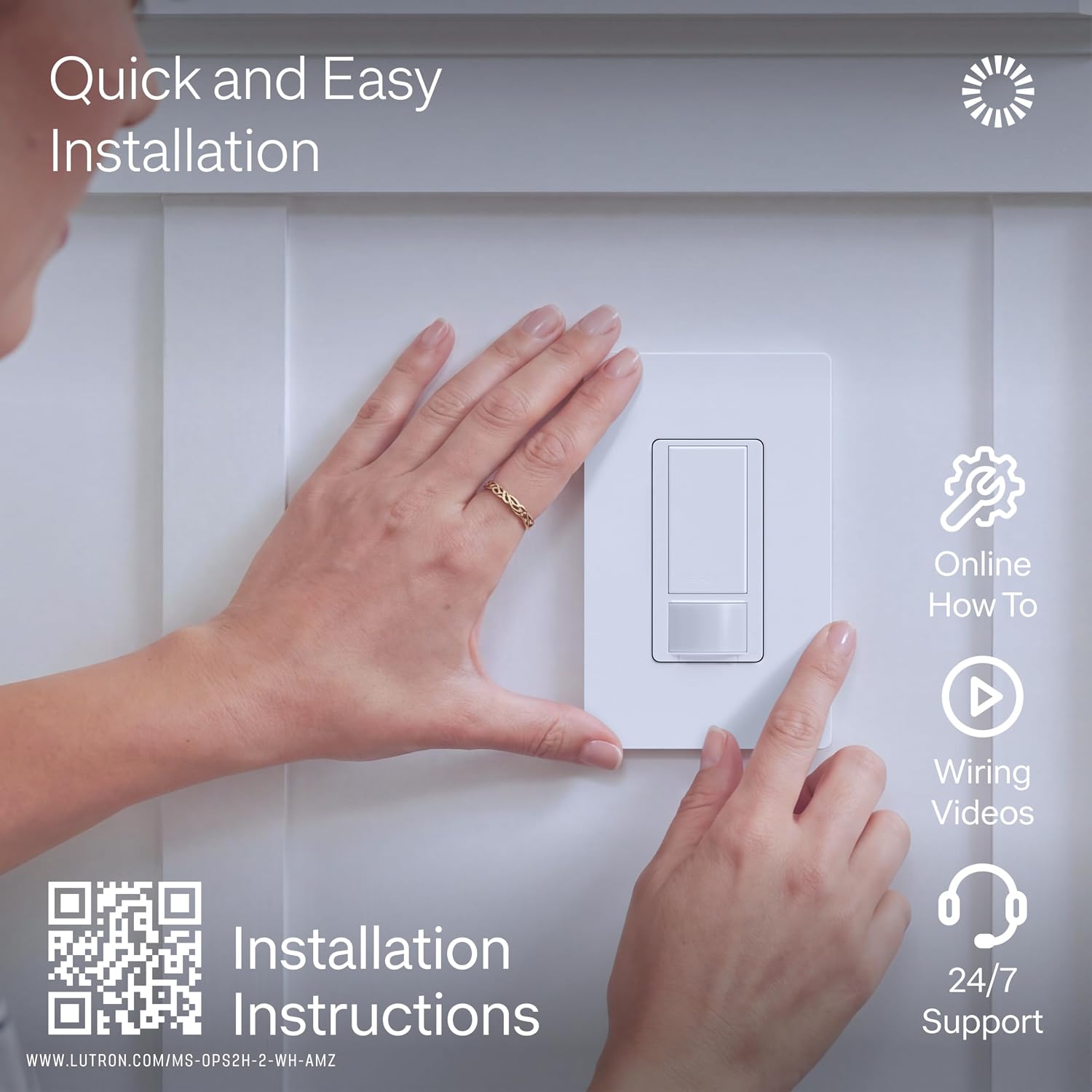
Check price on AmazonLutron’s occupancy sensor switch earns its premium positioning through a consistent pattern in owner-reported long-run use: people install it and stop thinking about it. Reviewers in laundry room and entryway applications specifically note that it holds occupancy detection reliably without false-off events mid-task. The slide-adjustable sensitivity dial on the face plate and 180-degree field of view help in oddly shaped rooms where other switches miss corners.
Per the Lutron Electronics MS-OPS2H-WH Specification Sheet, the switch supports a five-minute maximum adjustable timeout and does not require a ground wire. Retail pricing runs approximately $30–$40 as of mid-2026, which is the most common reviewer hesitation. Buying during major sale periods is a repeated recommendation in long-run reviews.
The documented tradeoff: the MS-OPS2H base SKU operates only in occupancy mode (auto-on, auto-off). If you want vacancy mode — manual-on, auto-off, preferred in bedrooms where you don’t want the light snapping on when you walk past at night — you need a different Lutron SKU or a different brand.
Lutron
$39.98
In stock on Amazon
Check price on AmazonELEGRP MS101P1 — The False-Trigger Fix
Leviton
$18.39
In stock on Amazon
Check price on AmazonELEGRP’s motion sensor switch occupies a mid-tier price point, typically $15–$22, and its owner review pattern tells a consistent story: buyers who switched away from unbranded or marketplace-sourced units explicitly cite ELEGRP as the solution to random false triggers. The phrase “zero false triggers” appears across multiple long-run reviews after six or more months of continuous use.
Per the ELEGRP MS101P1 Installation Guide, PIR sensitivity and timeout are adjustable via dials on the side of the switch body, and the unit is rated for LED, CFL, and incandescent loads. A ground wire is recommended where available but is not required for installation. For price-sensitive whole-home rollouts covering six or more switches, ELEGRP is the natural starting point before committing to the Lutron premium.
Leviton
$18.39
In stock on Amazon
Check price on AmazonTOPGREENER TDOS5 — The Terminal Quality Differentiator
GE
$19.90
In stock on Amazon
Check price on AmazonAmong the six switches compared here, TOPGREENER draws specific praise from electricians and careful DIYers for a build-quality detail that matters over a ten-year installation horizon: screw-clamp wire terminals rather than push-in (backstab) connectors. Backstab connectors on low-cost switches can work loose over years of thermal cycling, introducing intermittent connection failures that are genuinely difficult to diagnose. Screw terminals, torqued to specification, do not have this failure mode.
Per the TOPGREENER TDOS5-W Datasheet, both occupancy and vacancy modes are selectable via a physical switch on the unit body, and ground wire is not required. The minimum load threshold of approximately 2 W in no-neutral installations is the lowest in the group alongside the RAYZEEK, making it a practical fit for fixtures with very low-wattage LED lamps.
GE
$19.90
In stock on Amazon
Check price on AmazonRAYZEEK RZ036 — The True Manual Override
GE
$19.90
In stock on Amazon
Check price on AmazonThis is the most distinctive differentiator in the comparison, and if override behavior is your deciding criterion, it changes the recommendation entirely. Most motion sensor switches marketed as having a manual-on mode will still time out and shut the light off if no motion is detected — they are not true overrides, just an extended hold. Per owner-reported long-run testing documented across multiple home improvement forums and community review aggregators, the RAYZEEK RZ036 stays on indefinitely when toggled to manual mode until the user turns it off deliberately.
Per the RAYZEEK RZ036 Product Manual, the switch supports both occupancy and vacancy modes, does not require a ground wire, and is rated to 120 W maximum LED load — the lowest ceiling in the group, though adequate for nearly all residential fixture configurations. If your use case requires the light to remain on regardless of motion — a workshop, a home office during video calls, a reading nook — no other no-neutral switch in this price tier has been confirmed by owner testing to deliver a persistent manual override.
GE
$19.90
In stock on Amazon
Check price on AmazonLeviton DOS02 — The Installation-Confidence Pick
GE
$19.90
In stock on Amazon
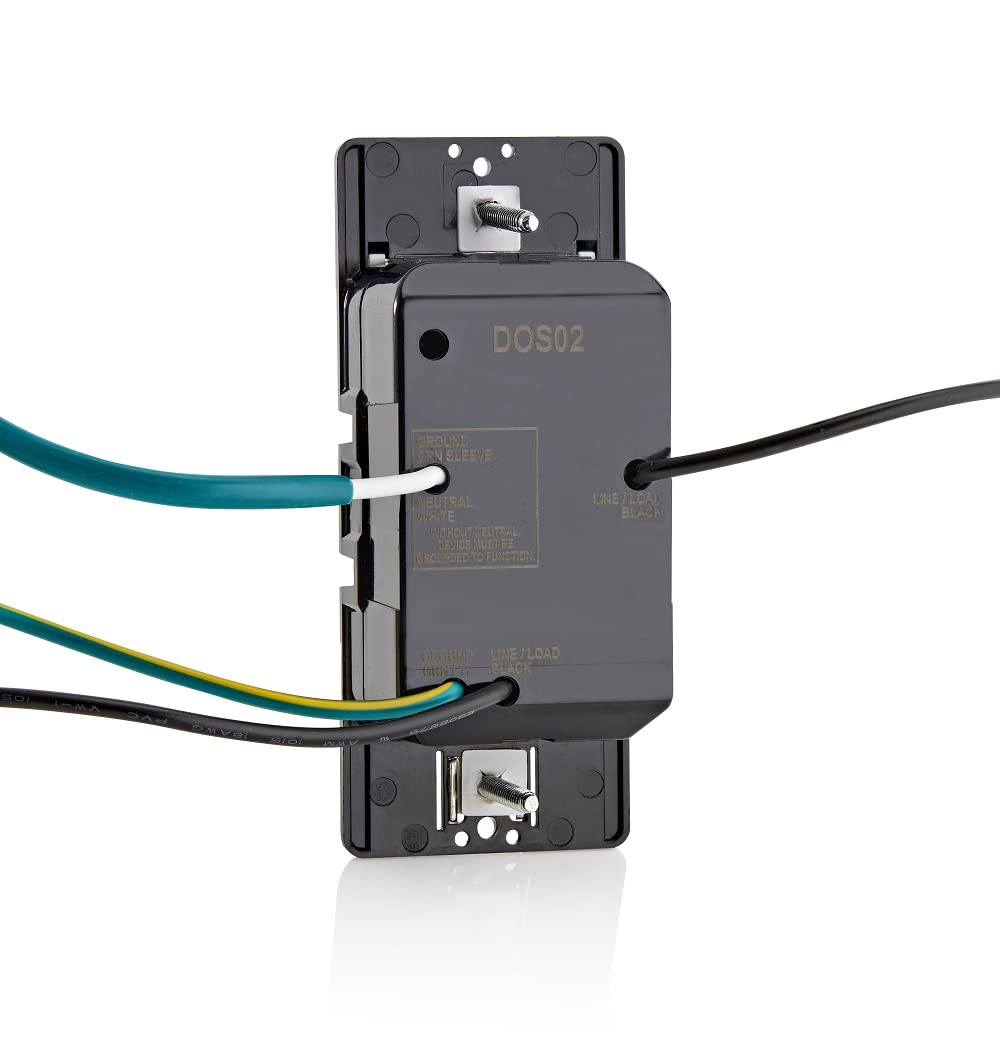
Check price on AmazonLeviton’s documentation quality is the headline differentiator here. Owner reviews from non-electricians specifically mention that the picture-based installation instructions gave them enough confidence to complete the install without calling a professional. The wiring diagrams are clear enough that first-time installers working in 1970s-era homes with unfamiliar wiring layouts report successfully identifying their conductors and completing the install.
Per the Leviton DOS02 Decora Occupancy Sensor Installation Instructions, the switch supports both occupancy and vacancy modes, is compatible with LED and CFL loads, and explicitly addresses two-wire (no-neutral) installations. Ground wire is recommended but not required per the published spec. For households where the installer is not an electrician and documentation clarity is a real selection variable, Leviton earns the recommendation on that basis alone.
GE
$19.90
In stock on Amazon
Check price on AmazonGE In-Wall PIR — The Batch Consistency Pick
GE
$19.90
In stock on Amazon
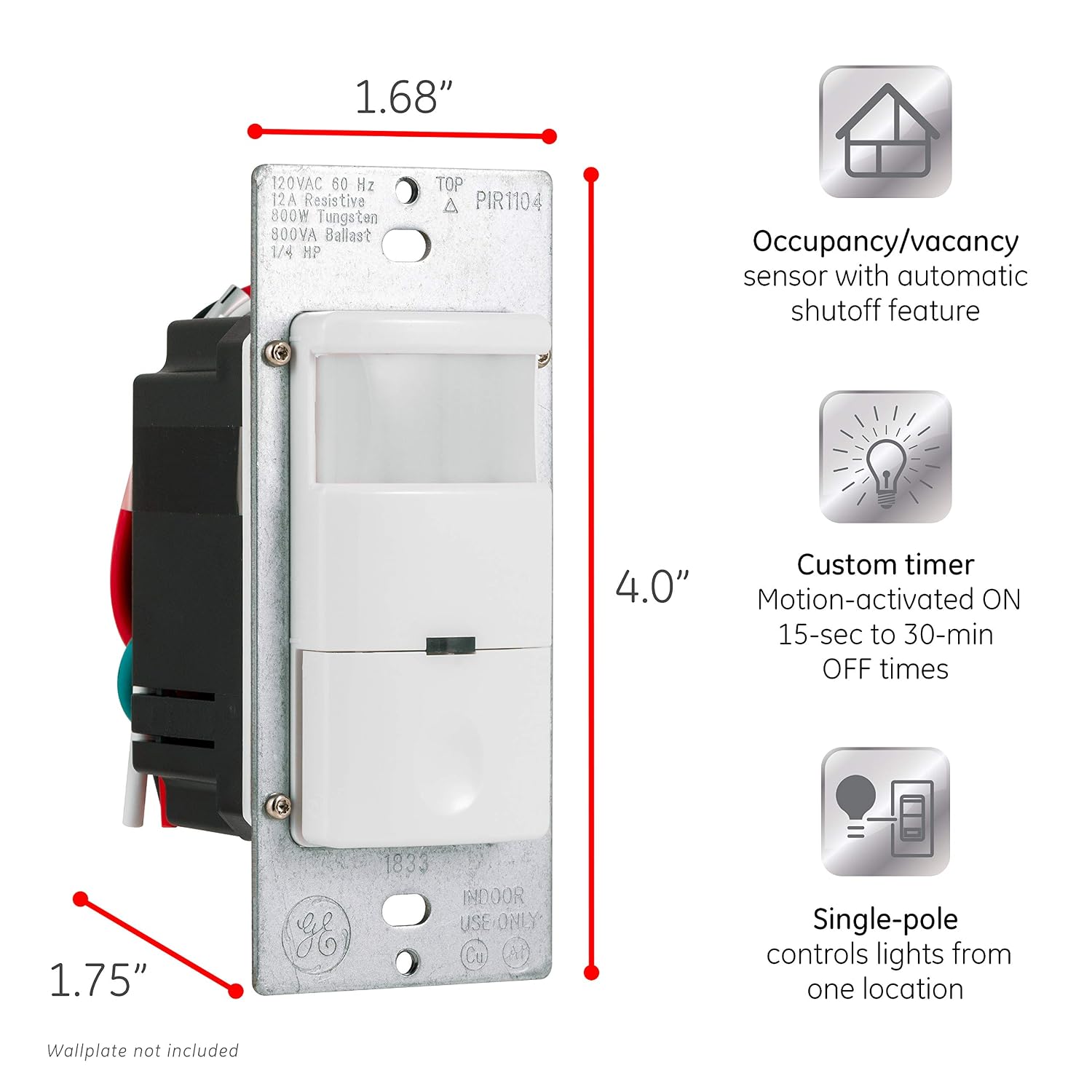
Check price on AmazonGE’s motion sensor switch does not win any single performance category, but owner reviewers who have installed eight or more units across a whole home or rental property consistently note that every unit behaves identically — same sensitivity, same timeout response, same wiring behavior unit to unit. That batch consistency matters when you are doing a building-wide retrofit and cannot afford to troubleshoot outliers.
Per the GE Lighting In-Wall PIR Motion Sensor Switch Specification Document, this model requires a ground wire — the only switch in this comparison with that hard requirement. Confirm your wiring before ordering. For boxes that do have a bare copper ground wire, which is common in homes built after the mid-1960s, GE is a strong choice for multi-unit uniformity.
GE
$19.90
In stock on Amazon
Check price on AmazonMode Selection and the Decision Rules
Occupancy mode vs. vacancy mode is a practical decision that buyers consistently get wrong at least once. Occupancy mode means the switch turns the light on automatically when it detects motion and turns it off automatically when motion stops. Vacancy mode means you turn the light on manually — by tapping the paddle — and the switch turns it off automatically when it no longer detects motion.
For closets and pantries: occupancy mode is almost always correct. Hands-free activation is the entire value proposition when your hands are full of laundry or groceries.
For bedrooms and hallways: vacancy mode is almost always better. You decide when the light comes on; the switch handles the off. The Apartment Therapy guide to smart home lighting (Apartment Therapy, “How to Choose the Right Motion Sensor Switch for Every Room,” published guidance on room-by-room mode selection) makes this same distinction as its primary recommendation framework.
Of the six switches above, TOPGREENER TDOS5 and Leviton DOS02 offer user-selectable mode switching on the unit itself without any additional hardware. Lutron’s MS-OPS2H base SKU is occupancy-only. RAYZEEK and ELEGRP support both modes via adjustment controls on the unit body. GE’s published documentation supports both modes.
Decision rules by use case:
- Reliability, price-flexible: Lutron MS-OPS2H. Buy on sale. Reviewers describe it as the switch they stop thinking about after installation, which is the highest compliment a switch can receive. Lutron — $39.98
- Six to twelve switches without breaking $200: ELEGRP MS101P1. False-trigger performance at this price tier is meaningfully better than unbranded alternatives, with consistent results confirmed across multi-unit installs. Leviton — $18.39
- Permanent install, ten-year terminal reliability: TOPGREENER TDOS5. Screw-clamp terminals are a real differentiator, not a marketing claim. GE — $19.90
- Light that stays on indefinitely on demand: RAYZEEK RZ036. No other switch in this group delivers a confirmed persistent manual override per owner-reported long-run testing. GE — $19.90
- Non-electrician doing the install: Leviton DOS02. Documentation quality is the product. GE — $19.90
- Eight or more units, batch consistency required: GE In-Wall PIR — but only if your boxes have a ground wire. GE — $19.90
Frequently Asked Questions
Will these switches work in a 1970s house with no neutral wire? Yes — all six models listed here support no-neutral installations, sometimes called two-wire installations. You need a hot wire and a switched-hot wire. If you have only two wires and neither is bare copper, you almost certainly have a no-neutral box. Per their published specification documents, Lutron, TOPGREENER, and RAYZEEK do not require a ground wire. Leviton DOS02 also supports no-ground per its installation instructions. ELEGRP and GE recommend a ground where available.
What is the difference between occupancy mode and vacancy mode, and which should I use in a closet? Occupancy mode is auto-on, auto-off — the switch does everything. Vacancy mode is manual-on, auto-off — you turn it on and the switch turns it off. For a closet, use occupancy mode. Hands-free activation when your arms are full is the point of the switch.
Why does my motion sensor switch turn the light off while I am still in the room? PIR sensors detect heat moving across their field of view. If you are sitting still — reading, working at a counter — you may not generate enough thermal movement to reset the timer. Solutions: increase the sensitivity setting, increase the timeout duration, or switch to a model with a wider field-of-view angle. Lutron’s 180-degree coverage per its published specification sheet helps in oddly shaped rooms. If you need the light to stay on regardless of activity level, the RAYZEEK RZ036’s confirmed true manual override solves this structurally.
Does any of these switches have a true manual override that does not time out? Based on owner-reported long-run use, the RAYZEEK RZ036 is the only switch in this comparison confirmed to hold manual-on indefinitely. Other brands advertise a manual mode, but owner reports consistently describe the light still shutting off after the timeout period elapses in those products.
Can these switches handle LED bulbs without flickering? All six are rated for LED compatibility per their published spec sheets and installation guides. The practical risk is minimum load: if your bulb draws fewer watts than the switch’s minimum load threshold, you may see flicker or ghost glow. Replacing a 4 W LED with a 9 W LED in the same fixture typically resolves flickering without any other change.
Is a ground wire required for all of these models or only some? Only the GE In-Wall PIR requires a ground wire per its published installation documentation. Lutron, TOPGREENER, RAYZEEK, and Leviton DOS02 explicitly support no-ground installations per their respective published specs. ELEGRP recommends a ground where available but does not mandate it. If your box has a bare copper wire tucked in the back, connect it regardless — it is a safety conductor.