A motion sensor light switch is exactly what it sounds like: a standard wall switch that replaces your manual toggle and uses a passive infrared (PIR) sensor — a heat-and-motion detector — to turn lights on when you enter a room and off after you leave. If you’ve ever walked into a dark utility room with your hands full, or opened an electricity bill that made you wince because someone left the bathroom light on all weekend, you already understand the pitch. This comparison is for the reader who’s past “should I install one?” and is now staring at a browser tab full of near-identical product listings trying to figure out which brand is worth the money. We’ll work through Lutron, Leviton, ELEGRP, TOPGREENER, GE, and RAYZEEK on the five specs that drive most purchasing decisions — neutral wire requirements, override behavior, 3-way compatibility, temperature tolerance, and timeout range — drawing on published manufacturer specification sheets and aggregated owner review patterns across major electrical supply distributors as of May 2026.
| EDITOR'S PICKLutron Maestro Motion Sensor Li… | Mid-tierLeviton Decora Occupancy Motion… | Budget pickLeviton Motion Sensor Light Swi… | |
|---|---|---|---|
| Neutral wire | — | — | No Neutral |
| Amperage | — | 15A | 2A |
| Location | Indoor | — | — |
| Sensor type | Occupancy Vacancy | Occupancy | Motion Activated |
| Wiring | Single-Pole | Single Pole | Single Pole |
| Price | $39.98 | $35.66 | $18.39 |
| See on Amazon → | See on Amazon → | See on Amazon → |
The Comparison Matrix: Six Brands at a Glance
Before diving into narrative, here’s where each brand stands on the specs that separate them in real installations.
| Brand / Model | Neutral Required | True Manual Override | 3-Way Without Hub | Temp Range | Max Timeout |
|---|---|---|---|---|---|
| Lutron MS-OPS2 | No | No (auto-cancels) | No | 32–104 °F | 30 min |
| Leviton DOS15 | No | No | Yes | 32–104 °F | 30 min |
| TOPGREENER TDOS5-HL | No | No (auto-cancels) | No | 32–104 °F | 30 min |
| ELEGRP EMCR15 | No | Limited | No | 32–104 °F | 20 min |
| GE In-Wall Smart | Yes | App-configurable | Hub required | 32–104 °F | Unlimited (app) |
| RAYZEEK RZ-W07 | No | Yes — holds indefinitely | No | 14–122 °F | 30 min + hold |
Approximate single-pack price ranges (May 2026 distributor aggregates — verify before ordering; this category sees 10–20% swings on promotional cycles):
- Lutron MS-OPS2: ~$32–$38
- Leviton DOS15-1LZ: ~$28–$34
- RAYZEEK RZ-W07: ~$22–$28
- TOPGREENER TDOS5-HL: ~$18–$24
Brand-by-Brand Breakdown
Lutron MS-OPS2 — The Reliability Benchmark You Pay a Premium For
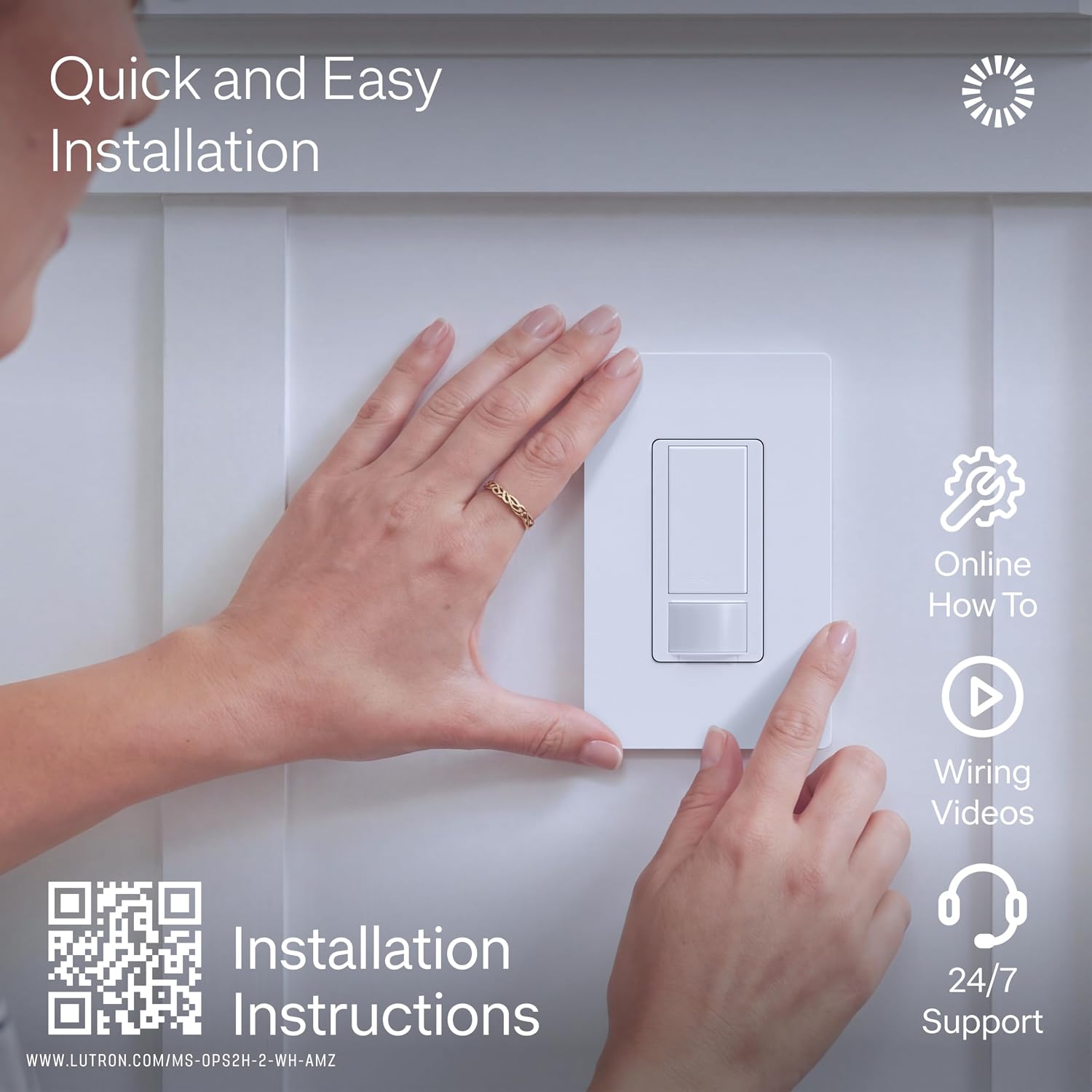
Lutron’s occupancy sensor switches sit at the top of the trust hierarchy in this category. Across aggregated reviews on major electrical supply platforms, the pattern is consistent: owners who have had Lutron switches for five or more years describe them as set-it-and-forget-it. According to the Lutron Electronics MS-OPS2 Occupancy Sensor Switch Product Specification Sheet, the switch is rated for 600W incandescent, 150W LED/CFL, and 0.5A motor loads — respectable coverage for residential and light-commercial use.
The tradeoff is behavioral, not electrical. Multiple owners flag that the MS-OPS2’s manual-on mode auto-cancels — meaning if you manually trigger the light to stay on while doing extended work in a room, the switch will eventually revert to occupancy mode and shut off when it determines the space is empty. For a laundry room that’s annoying. For a workshop or medical exam room it’s a deal-breaker. Lutron’s own documentation describes the override as time-limited, not persistent.
The price premium is real. Reviewers on commercial distributor platforms note that multi-pack pricing gets more competitive above quantities of ten. If brand reliability and long-term manufacturer support matter to a building’s maintenance team, Lutron earns its place on the bill of materials. If persistent manual override is required, look elsewhere.
Lutron
$39.98
In stock on Amazon
Check price on AmazonLeviton DOS15 — The 3-Way Specialist That Works Without a Hub
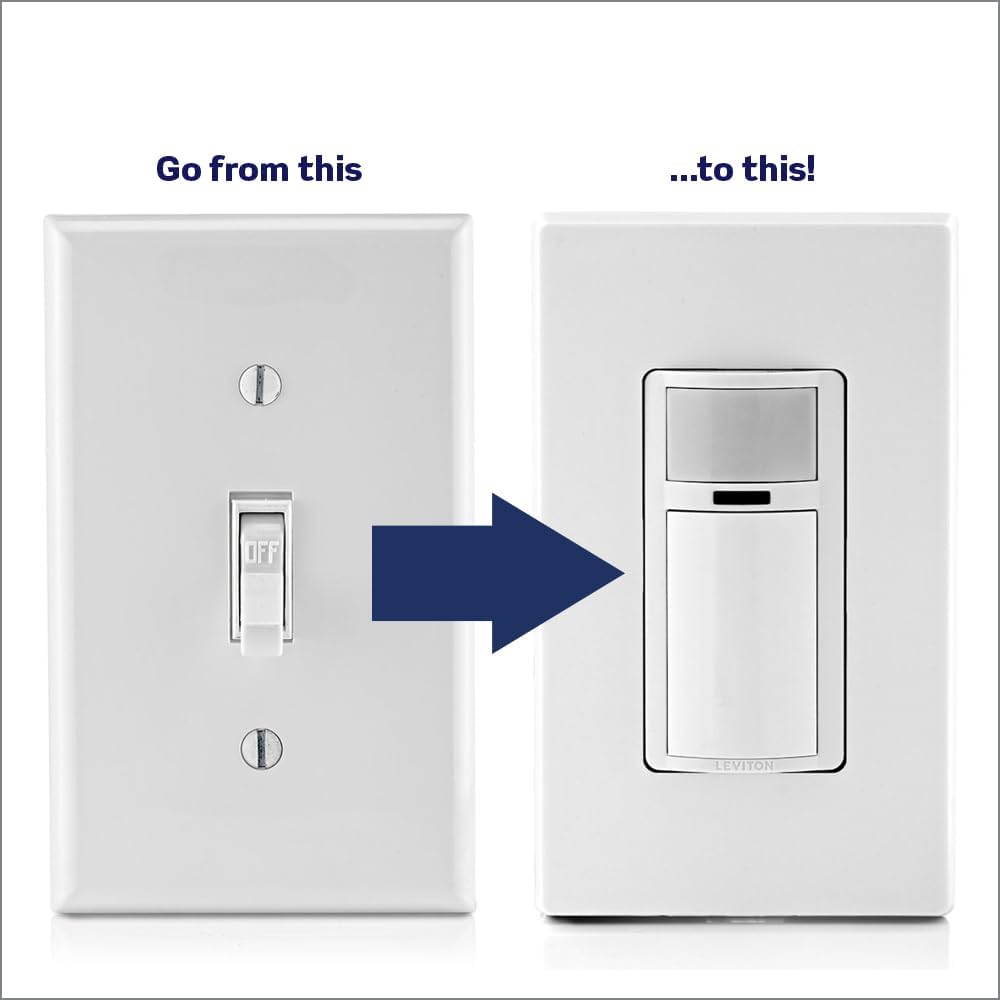
Leviton’s DOS15 occupancy sensor occupies a specific niche that almost no competitor touches: it is one of the few non-smart, standalone motion sensor switches rated for true 3-way operation — two switches controlling one light fixture from separate locations — without requiring a smart hub, a bridge device, or a neutral wire. According to the Leviton Manufacturing DOS15-1LZ Decora Motion Sensor Product Data Sheet, the switch supports 3-way wiring using a standard traveler wire configuration.
Owners who single out the DOS15 are almost always solving a specific problem: a hallway with entry points at both ends, a staircase, or a large commercial corridor where a single-pole sensor won’t cover the geometry. Operating without a hub is a genuine differentiator from Z-Wave or Zigbee alternatives in this use case — no subscription, no cloud dependency, no pairing frustration.
Apartment Therapy’s editorial coverage of motion sensor light switch installation considerations identifies 3-way occupancy wiring as one of the most commonly encountered installation challenges in this product category, which tracks with why DOS15 owners are consistently vocal about the feature. Limitation: like Lutron, Leviton’s manual override is not persistent. Timeout maxes out at 30 minutes per published specs.
Leviton
$35.66
In stock on Amazon
Check price on AmazonTOPGREENER TDOS5-HL — Solid Hardware, One Mechanical Annoyance
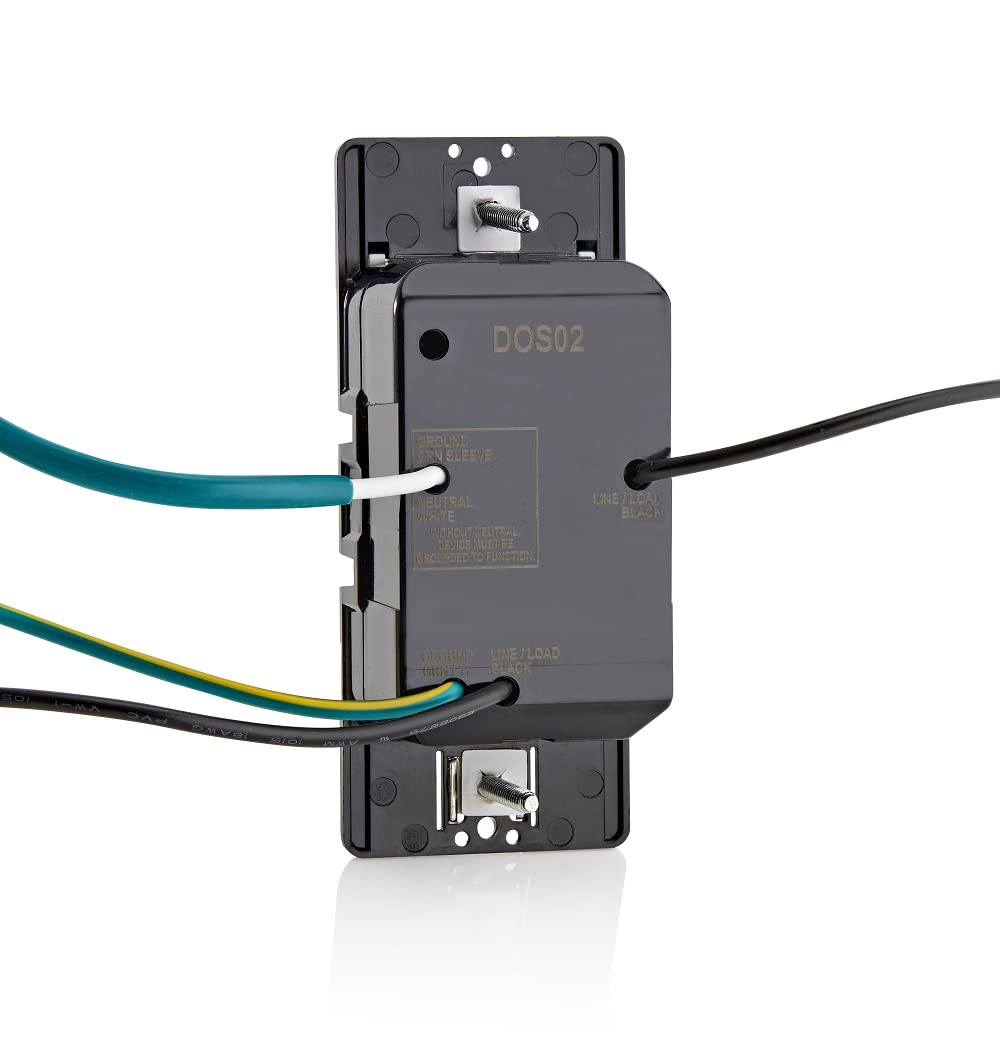
TOPGREENER’s TDOS5-HL earns consistent praise in one specific area that practitioners notice during installation: the screw-clamp wire terminals. Reviewers repeatedly describe these as easier and more secure than the back-stab push-in connectors common on budget switches, where wire retention depends on a spring clip that can loosen over time. Screw-clamp terminals matter in commercial retrofits where the box won’t be revisited for years.
The one hardware complaint that surfaces repeatedly is the cover-plate screw — specifically the Phillips head used to secure the decorative plate, which owners describe as stripping easily during installation. It’s a negligible-cost component on a mid-range switch, but it generates disproportionate frustration during multi-unit retrofits. Worth having a quality Phillips bit or JIS screwdriver on hand.
Per the TOPGREENER TDOS5-HL Occupancy Sensor Switch Specification Sheet, the switch carries the same auto-canceling override limitation as the Lutron MS-OPS2. If your application is a standard room where you want lights off when the space is empty and can tolerate occasional re-triggering during a long work session, this is a competitive option at its price point. If persistent hold is required, it does not deliver.
Leviton
$35.66
In stock on Amazon
Check price on AmazonELEGRP EMCR15 — The “Done With Cheap Knockoffs” Upgrade
ELEGRP positions itself as the step up from the flood of no-name, ultra-budget units that have saturated the market since 2023. Owners who review ELEGRP frequently describe a specific migration story: they bought something cheaper, experienced false triggers from HVAC airflow, vibration, or thermal drift rather than actual human movement, and switched to ELEGRP for stable performance.
Published specs on the EMCR15 show a 180-degree detection angle and a 15-foot (4.5m) detection radius — conservative specs, but ones that align with the no-false-trigger feedback pattern. A wide detection range paired with aggressive sensitivity tuning is a common cause of false positives; ELEGRP’s tighter default sensitivity appears to be a deliberate design tradeoff rather than a limitation.
The timeout ceiling at 20 minutes is the shortest in this comparison group. For high-traffic spaces like bathrooms and corridors 20 minutes is more than adequate. For spaces with extended stationary occupancy — a server room, a reading nook, or a conference room where someone sits still for 45 minutes — this ceiling matters and should factor into the selection decision.
Leviton
$18.39
In stock on Amazon
Check price on AmazonGE In-Wall Smart Motion Sensor — The App-Configured Outlier
GE’s smart motion sensor switches operate in a different category entirely. They require both a neutral wire and a Z-Wave or Zigbee hub to unlock their full feature set, including unlimited timeout configuration via app. Reviewers who choose GE in this category are specifically willing to trade installation complexity for scheduling flexibility and remote override capability.
The neutral wire requirement is a hard constraint in older wiring systems. If the junction box lacks a neutral — common in pre-1990s residential wiring — GE’s smart switches are off the table without a rewire. For new construction or commercial retrofit with full wire runs, this constraint disappears. The app-configurable timeout, which reviewers confirm can be set to never turn off, is genuinely useful for conference rooms, server areas, and spaces where motion sensing is wanted as a convenience feature rather than a mandatory auto-off function.
Sensors Magazine (sensorsmag.com), in its coverage of PIR sensor integration in building automation contexts, notes that smart-switch platforms with hub integration provide significantly more tunable sensitivity and timeout behavior than standalone analog switches — a point directly relevant to the GE platform’s value proposition versus the standalone options in this comparison.
Lutron
$39.98
In stock on Amazon
Check price on AmazonRAYZEEK RZ-W07 — The True Override Champion
RAYZEEK’s differentiation is a single feature that owners describe with unusual clarity: a true manual override that holds the light on indefinitely without auto-canceling. This is the switch reviewers recommend when the Lutron MS-OPS2 or TOPGREENER TDOS5-HL keeps interrupting a work session. Per the RAYZEEK RZ-W07 Motion Sensor Switch Specification Sheet, the switch achieves this through a toggle-mode hold that persists until the user manually switches it off — the sensor goes dormant while hold mode is active.
The second differentiator is operating temperature range. The RAYZEEK RZ-W07 specification sheet documents a 14–122 °F (-10–50 °C) operating range versus the 32–104 °F (0–40 °C) stated on most competitors’ data sheets. That 18-degree extension at the cold end is material for unheated garages, storage units, and northern-climate outdoor-adjacent spaces. Owners in cold climates specifically cite this spec as the reason they chose RAYZEEK over Lutron.
The limitations are the same ones affecting most non-smart switches: no hub integration, no native 3-way support, and no remote configuration. If the installation is a single-pole circuit in a space with temperature extremes and persistent override is required, the spec profile fits the use case cleanly.
Leviton
$35.66
In stock on Amazon
Check price on AmazonThe ECOELER 10-Pack Calibration Quirk Worth Knowing
A pattern worth flagging for anyone evaluating bulk-pack budget options: ECOELER’s 10-pack units, a popular choice for multi-unit residential retrofits, carry a calibration behavior that owners have documented across multiple distributor review platforms but that does not appear in the product listing or manual. Reviewers note that stubborn units — ones that seem too sensitive or not sensitive enough out of the box — require cycling the sensitivity dial multiple times through its full range before the sensor settles into stable behavior. It is not a defect in the traditional sense, but it is undocumented. If you are doing a bulk install and a handful of units appear miscalibrated on first power-up, run the sensitivity dial through three to five full cycles before concluding the unit is faulty.
Frequently Asked Questions
1. Do any of these switches work without a neutral wire AND without a ground wire? Several switches in this comparison — including the Lutron MS-OPS2, Leviton DOS15, and TOPGREENER TDOS5-HL — are specified as no-neutral designs that draw operating power through the load. However, none of the major brands in this group officially support operation without a ground wire. In practice, some owners in older homes report installing these switches without a ground with no immediate failure, but this creates a code compliance issue and may void the UL listing. The safe answer: no ground, no compliant installation.
2. Which switches support a true manual override that doesn’t auto-cancel? Based on published specs and aggregated owner reports, the RAYZEEK RZ-W07 is the clearest example of a persistent hold that does not auto-cancel. The GE smart switch achieves the same outcome via app configuration but requires a hub. Lutron MS-OPS2, TOPGREENER TDOS5-HL, and Leviton DOS15 all implement time-limited overrides that revert to occupancy mode — owners consistently flag this in task-oriented spaces.
3. Can I run two sensors on one 3-way circuit without a smart hub? Yes, but options narrow significantly. The Leviton DOS15 is designed for true 3-way operation using standard traveler wire without any hub. Most other switches in this comparison require either a companion accessory switch (not a second sensor) or a smart hub for multi-point sensing. If hub-free 3-way operation is the requirement, the Leviton DOS15 is the practical answer.
4. Will these work reliably in a garage with large temperature swings? Most switches in this group are spec’d for 32–104 °F operation, which covers a heated garage but not an unheated one in a cold climate. The RAYZEEK RZ-W07 is the exception with a published 14–122 °F range. For unheated garages in regions that see sub-freezing winters, RAYZEEK’s temperature specification is a meaningful differentiator. Beyond temperature, PIR sensors in garages can false-trigger from vehicle radiant heat; reducing sensitivity to its lowest setting after installation is a standard mitigation.
5. How long does the timeout delay go, and can I set it longer than 5 minutes? All standalone (non-smart) switches in this comparison support timeouts beyond 5 minutes. Lutron, Leviton, and TOPGREENER publish a 30-minute maximum. ELEGRP tops out at 20 minutes. RAYZEEK reaches 30 minutes on the auto-off timer and adds persistent hold mode on top. The GE smart switch’s app removes the ceiling entirely. If you need a timeout longer than 30 minutes without a hub, RAYZEEK’s hold mode is the most practical option.
6. What happens if my house was built in the 1970s and has no ground wire? Pre-1980s wiring frequently uses two-wire runs with no equipment ground. Installing a motion sensor switch in an ungrounded box is a code compliance issue under NEC 2023. Options include running a new grounded circuit, or in some retrofit scenarios installing a GFCI outlet upstream of the switch — NEC permits GFCI protection as an alternative to a physical ground in certain cases, but confirm the specific application with a licensed electrician and local inspector before proceeding. No switch manufacturer in this comparison officially rates their products for ungrounded installations.
The Decision Rule
If you want the clearest if-X-then-Y framework:
- If reliability over a 5-plus year horizon is the priority and budget allows: Lutron MS-OPS2. Accept the auto-cancel override limitation.
- If you need 3-way operation without a hub: Leviton DOS15. Full stop.
- If you need persistent manual override or are installing in a cold unheated space: RAYZEEK RZ-W07. The temperature specification and hold mode are the differentiators.
- If installation terminal quality matters for a commercial retrofit: TOPGREENER TDOS5-HL — bring a quality screwdriver for the cover plate.
- If you are upgrading from unreliable budget units and want stable no-false-trigger performance at a mid-range price: ELEGRP EMCR15.
- If you want unlimited timeout configurability and have neutral wire plus a hub already in place: GE’s smart switch is the only option in this group that removes the timeout ceiling entirely.
The spec sheets are largely honest in this category. The real gap between brands is not in the listed numbers — it is in the behavioral details that only surface after six months of use. Owners have documented those patterns consistently enough that the picture holds up as a decision-making foundation.