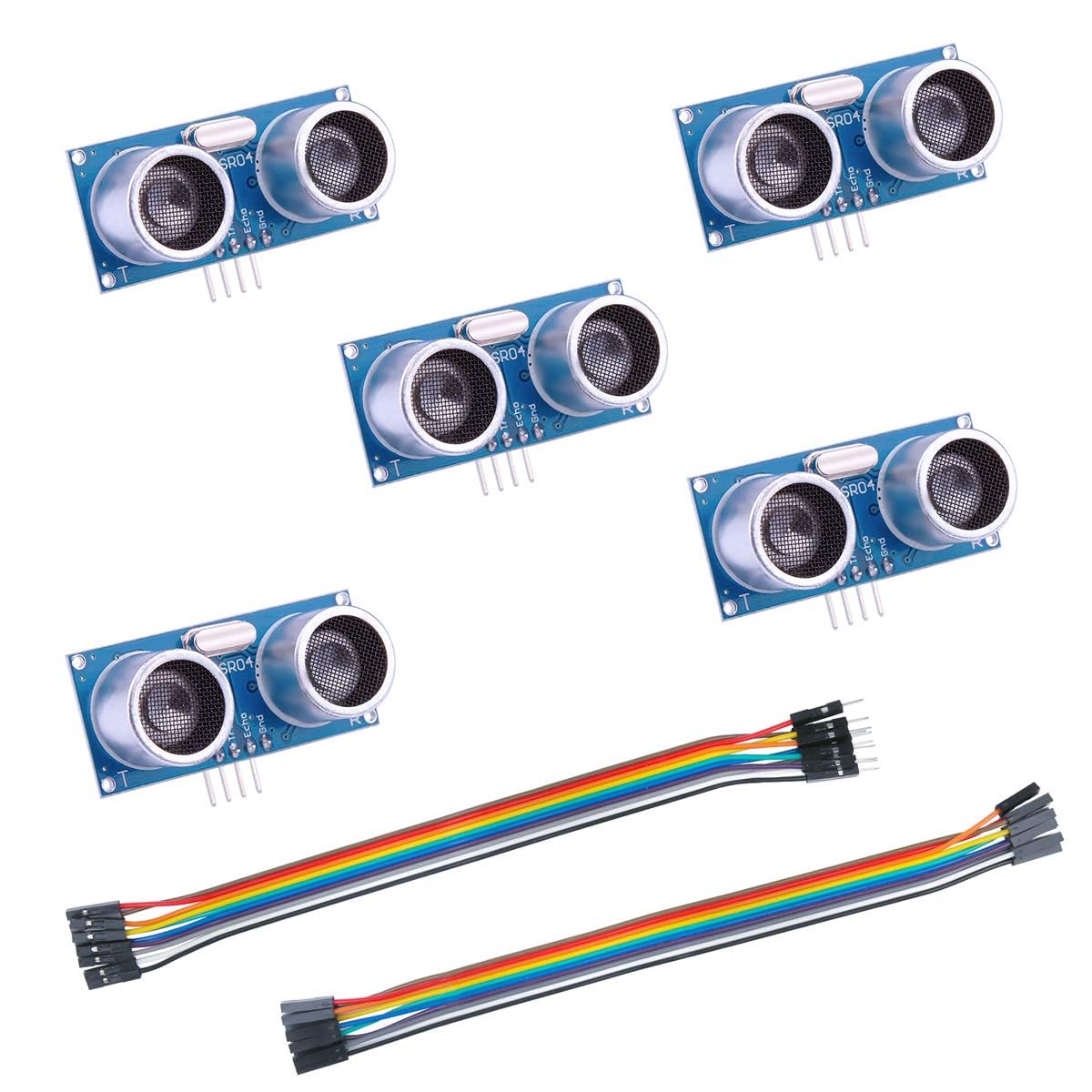
If you’ve ever tried to build an automatic water-level indicator, a robot that avoids walls, or a parts counter that detects when a bin is full, you’ve probably landed on the HC-SR04. It’s a small module — about the size of a matchbook — that sends out a pulse of high-frequency sound (40 kHz ultrasonic, meaning far above the range of human hearing) and measures how long the echo takes to bounce back from an object. That round-trip time converts directly to distance. The math is simple, the wiring is four pins, and modules sell for under a dollar apiece in quantity. The catch is that “HC-SR04” describes a category that spans wildly inconsistent build quality, no environmental sealing whatsoever in the standard form, and a 4-pin trigger/echo interface that can cause timing headaches in multi-sensor or interrupt-heavy firmware. This guide walks through what separates a reliable module from a frustrating one, when to reach for a waterproof variant, and when an I2C bridge board is worth the extra spend.
Why Pack Quality Actually Matters at $1 Per Module
The generic HC-SR04 is commodity hardware. Dozens of factories produce it to no unified quality standard, and the schematic variations are real. The most common issue reported across aggregated buyer reviews on Digi-Key, Amazon, and the Arduino forums is inconsistent echo pulse behavior — modules that work fine at 5 V bench power but drop readings intermittently when powered from a microcontroller’s 3.3 V or 5 V rail under load.
The root cause, documented in SparkFun’s HC-SR04 Hookup Guide, is usually one of two things: ceramic resonator tolerance on the 40 kHz oscillator, or op-amp gain variation on the receive comparator. Neither is visible from the outside of the module. The practical implication is that cheap 5-packs sourced from gray-market channels may have one or two units that exhibit a 2–5 cm systematic offset or intermittent no-echo returns, requiring you to build software workarounds that wouldn’t be necessary with a better-specified part.
What to look for in a quality module:
- Stable 5 V supply current draw under 15 mA during burst. Some clone modules spike to 30 mA, which can brown out an Arduino Uno’s onboard regulator if you’re also driving servos.
- Clearly labeled IC markings. Legitimate HC-SR04 designs use an NE555 or equivalent timer and a CX20106 or LM324 op-amp. Boards with unmarked or sanded ICs offer no visibility into the actual silicon.
- PCB silkscreen accuracy. Trig and Echo pins swapped on the silkscreen is a known issue on some batches; reviewers on multiple electronics forums document this.
- Consistent response across the rated 2 cm – 400 cm range. Per the published HC-SR04 datasheet, usable accuracy is ±3 mm under ideal conditions. Modules that can’t hit ±1 cm at 50 cm are outliers that will cost you debugging time.
By the Numbers: HC-SR04 Core Specs
| Parameter | Rated Value | Notes |
|---|---|---|
| Operating voltage | 5 VDC | 3.3 V possible with level-shifter |
| Max range | 400 cm (4 m) | Practical reliable limit ~250 cm indoors |
| Min range (blind zone) | 2 cm | Objects closer than 2 cm return no echo |
| Beam angle | ~15° cone | Wider objects = better detection |
| Trigger pulse width | ≥10 µs | Narrower pulses often fail to fire |
| Current draw (burst) | ~15 mA typical | Spikes higher on low-quality boards |
The 250 cm practical limit cited above is consistent with application notes from Maxbotix’s ultrasonic sensor documentation library, which notes that soft, sound-absorbing surfaces (foam, fabric, loose bulk materials) can reduce effective range by 30–50% compared to hard reflective targets.
Waterproof Variants: When the Standard Module Isn’t Enough
The standard HC-SR04 is rated for indoor, dry environments. No IP (Ingress Protection) rating is published because none applies — the PCB is open and uncoated. If your application involves any of the following, you need a sealed variant:
- Outdoor mounting (rain, condensation, temperature cycling)
- Tank or reservoir level sensing (humid atmosphere above the liquid surface)
- Washdown environments (food processing lines, car washes, agricultural equipment)
- Dusty industrial enclosures (woodworking, bulk material handling)
The most widely deployed waterproof alternative is the JSN-SR04T (also sold as the A02YYUW in some markets). It uses a separate waterproof transducer connected to a small control board via a twisted-pair cable, so the electronics stay dry even when the sensor face is exposed to liquid splash or immersion up to the cable entry point. Published specs put the transducer housing at IP67 (sealed against temporary immersion to 1 meter for 30 minutes), though the control board itself is not sealed and must be mounted in a dry enclosure.
Trade-offs vs. standard HC-SR04:
- Blind zone increases to ~20–25 cm (vs. 2 cm for HC-SR04). This is a fundamental physics trade-off: the waterproof transducer uses a larger piezo element with more ring-down time. If you need to detect objects closer than 20 cm, the JSN-SR04T is the wrong tool.
- Cable length adds latency and noise susceptibility. The included cable is typically 2.5 m. Beyond that, shielded cable is recommended to prevent EMI pickup from motor drives or switching power supplies.
- Price premium is real but modest. Individual units in mid-2026 distributor pricing run $4–$8 versus $0.80–$2.00 for standard HC-SR04, based on current listings at AutomationDirect and Amazon. For a BOM with five or fewer sensors, this is negligible. At 50+ units, it’s worth evaluating whether the IP67 rating is actually required for every mounting location.
A second waterproof option worth knowing is the DYP-ME007TX, which uses a similar separated transducer design but adds a configurable UART output mode, removing the need for precision µs-level echo timing in firmware. Adafruit’s Learning System guide to ultrasonic sensors with CircuitPython specifically calls out UART-output modules as a reliability improvement for MicroPython environments where interrupt latency can corrupt echo-width measurements.
I2C Bridge Options: When Pin Count or Timing Becomes the Real Problem
The standard HC-SR04 interface requires one GPIO for trigger and one for echo, plus your firmware must measure echo pulse width in microseconds. On an Arduino Uno with one sensor, this is trivial. The problems multiply when you have:
- Multiple sensors (3+ units competing for GPIO and timer resources)
- RTOS or interrupt-heavy firmware where a blocking
pulseIn()call introduces latency jitter - 3.3 V-only MCUs (ESP32, RP2040, STM32) where 5 V HC-SR04 echo signals require level shifting or risk damaging GPIO inputs
- Long sensor cable runs where the digital echo signal is susceptible to noise
The I2C upgrade path solves most of these simultaneously. The most common approach is a VL53L0X (time-of-flight laser, not ultrasonic) or an HC-SR04-to-I2C bridge board that wraps the ultrasonic module behind an I2C register interface. The latter is sold under names like “HC-SR04 I2C Adapter” and is available through the major distributors.
However, the more honest recommendation for practitioners upgrading from HC-SR04 on the basis of interface limitations is to skip the bridge and evaluate purpose-built I2C ultrasonic modules directly:
- Maxbotix MB1242 (I2CXL-MaxSonar-EZ4): I2C native, 7-bit address configurable, 3.3 V–5 V compatible, 20 cm–765 cm range, IP00 (open board). Per Maxbotix’s published application notes, the I2C interface supports up to 10 devices on a single bus with address configuration. Street price in May 2026 runs approximately $25–$35 each at Digi-Key and Mouser.
- RCWL-1601: HC-SR04 pin-compatible but 3.3 V tolerant on the echo pin, reducing level-shifter overhead in 3.3 V systems. Not I2C, but eliminates the most common hardware headache for ESP32/RP2040 designs.
The MB1242 at $30 versus a $1.50 HC-SR04 is a 20× cost multiplier that requires explicit justification. The cases where it’s clearly worth it:
- Four or more sensors on one controller — I2C bus sharing eliminates 6+ GPIO lines
- Production volumes where firmware debug time costs real money — the MB1242’s consistent, documented behavior reduces integration risk
- Mixed-voltage PCB designs where a single 3.3 V bus simplifies power rail design
Per the Texas Instruments TIDA-00174 ultrasonic distance measurement reference design documentation, multi-sensor systems above four units almost universally benefit from bus-based interfaces over individual GPIO pairs, primarily due to PCB routing complexity and the difficulty of synchronizing echo capture across multiple interrupt service routines.
The Decision Framework: Which Variant for Your Situation
Here’s the explicit trade-off map. Name your constraint, pick your path.
If X = prototype or classroom project with one or two sensors, indoor, 3.3 V MCU with level-shifting already on your breakout board: → Standard HC-SR04 5-pack from a reputable distributor (not gray-market). Budget $8–$15 for the pack, accept that one unit might need replacement. Keep the firmware simple.
If X = outdoor mounting, humid enclosure, or any risk of water splash: → JSN-SR04T waterproof variant, waterproof transducer to dry control board. Verify that your minimum detection distance requirement is above 20 cm before committing. (Amazon: JSN-SR04T Waterproof Ultrasonic Sensor — affiliate link)
If X = three or more sensors on one MCU, 3.3 V system, or interrupt-heavy RTOS firmware: → Evaluate Maxbotix MB1242 or equivalent native I2C ultrasonic. The per-unit cost is higher, but the integration engineering cost almost always justifies it above four sensors.
If X = 3.3 V system, single sensor, cost-constrained: → RCWL-1601 as a drop-in, 3.3 V-tolerant alternative to HC-SR04. Same four-pin interface, compatible libraries, no level-shifter required.
If X = very short detection distances (under 10 cm) with high accuracy: → Ultrasonic is the wrong technology entirely. Look at time-of-flight laser sensors (VL53L1X family); as Sensors Magazine’s overview of ultrasonic vs. optical sensing notes, ultrasonic sensors have fundamental near-field blind zones driven by transducer ring-down physics that cannot be tuned away in software.
The HC-SR04 earns its place in the toolkit because it’s cheap, broadly supported, and good enough for a large class of distance sensing problems. The mistake is treating “HC-SR04” as a single defined product rather than a specification floor with significant quality variance above and below it. Match the variant to the environmental and interface requirements first, then optimize for cost within that constraint — not the reverse.