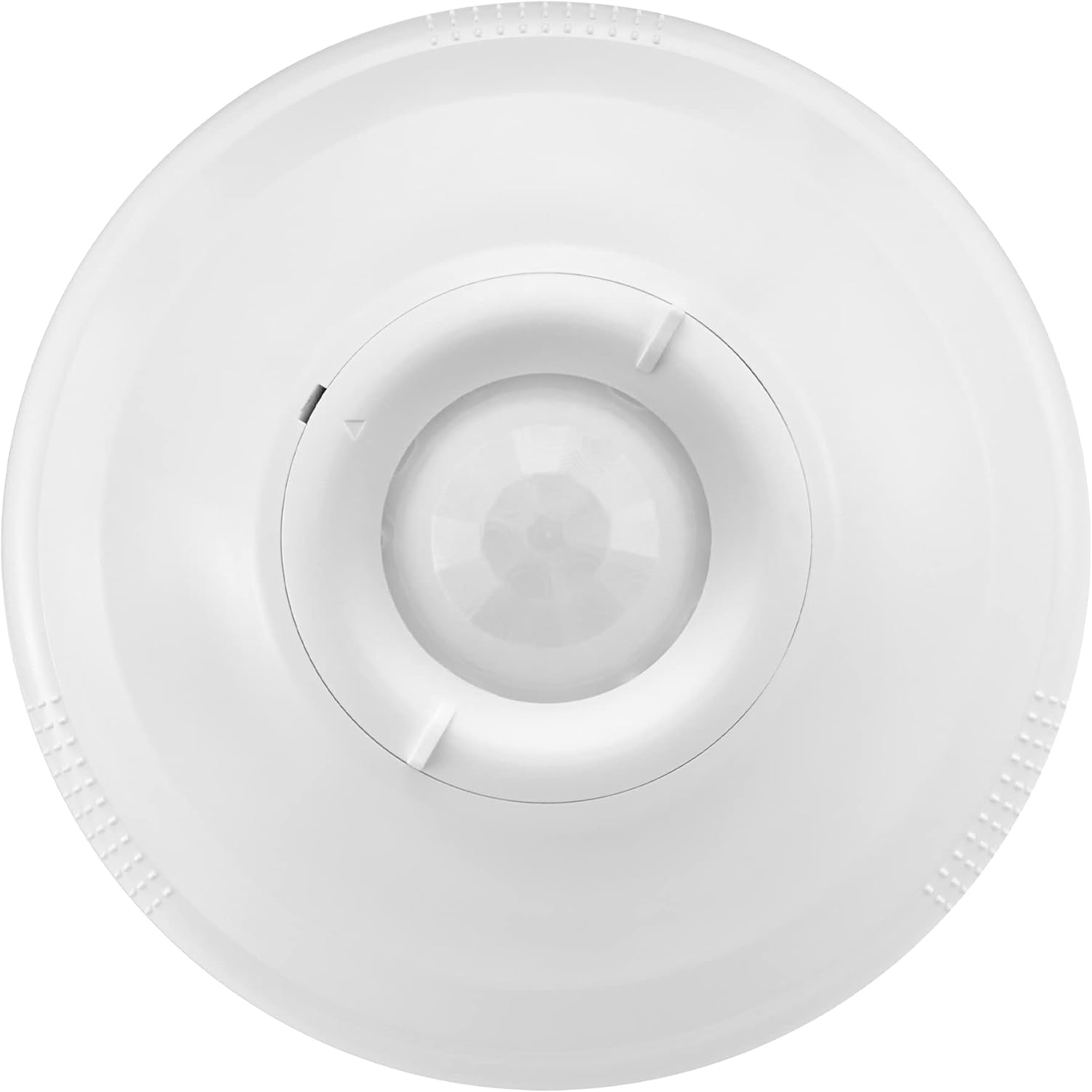
A ceiling occupancy sensor is a passive infrared (PIR) detector — “passive” because it reads heat differences rather than emitting a signal — mounted overhead to automatically switch lights on when someone enters a space and off after they leave. The appeal in a garage or workshop is obvious: your hands are full of groceries or you’re wearing gloves mid-project, and you shouldn’t have to fumble for a switch. But the gap between a sensor’s advertised detection range and its actual coverage in a cluttered, insulated, or cold garage is where most buyers get burned. This guide synthesizes what owners across hundreds of verified purchases consistently report about four of the most-reviewed ceiling PIR options in the $15–$80 residential and light-commercial tier — Maxxima, ECOELER, Sensor Switch CMR 10, and RAYZEEK — so you can match the right unit to your space before you’re standing on a ladder with buyer’s remorse.
| EDITOR'S PICKSensor Switch CMR 10 Contractor… | Mid-tierECOELER Ceiling Occupancy Motio… | Budget pickECOELER Ceiling Occupancy Motio… | |
|---|---|---|---|
| Relay | ✓ | — | — |
| Voltage | — | 120/277VAC | 120/277VAC |
| Coverage | Extended Range | 360° | 360° |
| Certif. | — | UL, FCC | UL, FCC |
| Price | $52.80 | $13.59 | $13.59 |
| See on Amazon → | See on Amazon → | See on Amazon → |
What Real Owners Are Actually Saying (And Where the Spec Sheets Lie)
Start with the most common complaint across all four brands: detection range is systematically overstated when real garage conditions are involved.
One ECOELER buyer is direct in their review: the 20-foot range claim is “a stretch in real conditions.” That tracks with what Sensors Magazine covers in its reporting on PIR performance variables — ambient temperature differential between the occupant and the background environment is the dominant driver of sensitivity, and in an uninsulated garage where wall and floor temperatures can approach body temperature in summer, PIR discrimination collapses well before the spec-sheet maximum. The spec assumes an ideal test environment, not a Texas garage in August or a Michigan shop in January with a propane heater running. Sensors Magazine, published by Endeavor Business Media, covers this dynamic in its analysis of real-world PIR enclosure performance.
RAYZEEK buyers surface a related but distinct issue: the sensor triggers only after you’ve stepped fully into the garage, not at the threshold. For a motion-activated light, that’s a significant usability failure — you’re reaching for a switch anyway. This is a lens geometry and mounting-height problem. PIR sensors use a Fresnel lens — a segmented optical element that divides the coverage zone into detection lobes — to define their field of view. At typical 8–10 ft ceiling heights, the outermost lobes of many budget PIR units don’t reach the doorway plane when mounted at the center of the room. If your ceiling is lower or your garage is deeper than 20 feet, you’re working with a geometry mismatch from the start. Control Engineering, published by CFE Media, addresses this lens geometry limitation in its guidance on occupancy sensor selection for building automation.
Maxxima owners discovered a failure mode that appears on no spec sheet: IR security cameras triggering false-on events throughout the night. This is not a fringe case — multiple independent reviewers report it. The mechanism is straightforward: IR illuminators on night-vision cameras emit in the 850–940 nm range, which overlaps with the infrared sensitivity window some PIR pyroelectric elements respond to under certain lens and circuit configurations. Maxxima had not publicly addressed this in updated product documentation as of May 2026. If you have IR cameras in or near your garage, this is a disqualifying defect for that brand under current documentation.
Brand-by-Brand Decision Frame
Sensor Switch CMR 10 — Best for Large Spaces, Patience Required
Sensor
$52.80
In stock on Amazon
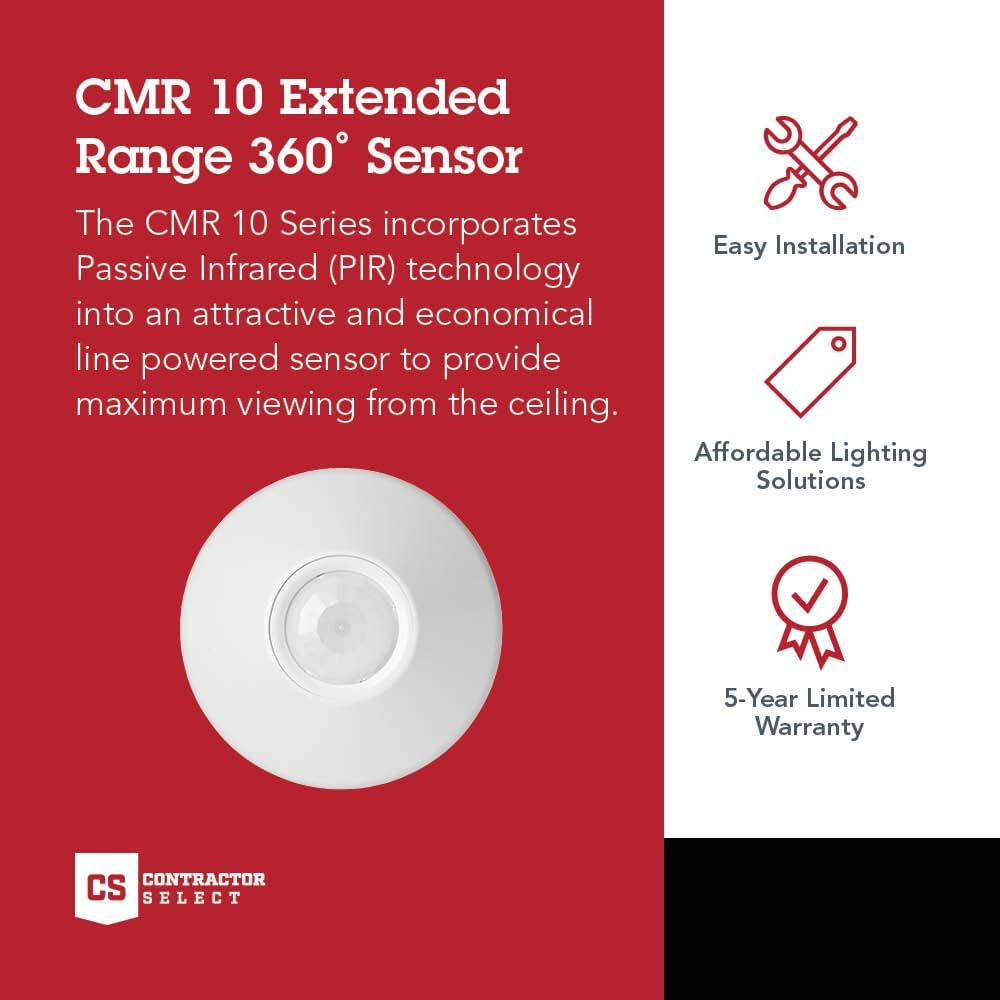
Check price on AmazonThe Sensor Switch CMR 10, a commercial-grade ceiling-mount occupancy sensor from Acuity Brands, is the clear performance leader for coverage area. Buyers with large detached garages — multi-car, 24×24 ft or deeper — consistently rate it the most reliable for full-room detection without dead zones. Per Acuity Brands’ published CMR 10 installation and programming guide, the unit is rated for up to 1,000 sq ft in open-plan configurations, which puts it in a different tier from residential box-store options.
The tradeoff is programming. Multiple reviewers describe the time-delay and sensitivity calibration process as “tedious” — it requires holding buttons in specific sequences while watching LED blink patterns, with no mobile app and no digital display. For an integrator or facility manager who programs dozens of these, the learning curve flattens fast. For a homeowner installing one sensor in one garage, it’s a legitimate friction point. Budget 30–45 minutes for initial setup and keep the physical manual accessible; online documentation for this unit is sparse relative to the programming complexity.
If X, then Y: If your garage is over 400 sq ft, you’re comfortable working through a paper installation guide, and you want a sensor that will still be available through commercial distributors in five years — the CMR 10 is the right call.
ECOELER Ceiling Occupancy Sensor — The Smartest Installation Story in This Category
ECOELER
$13.59
In stock on Amazon
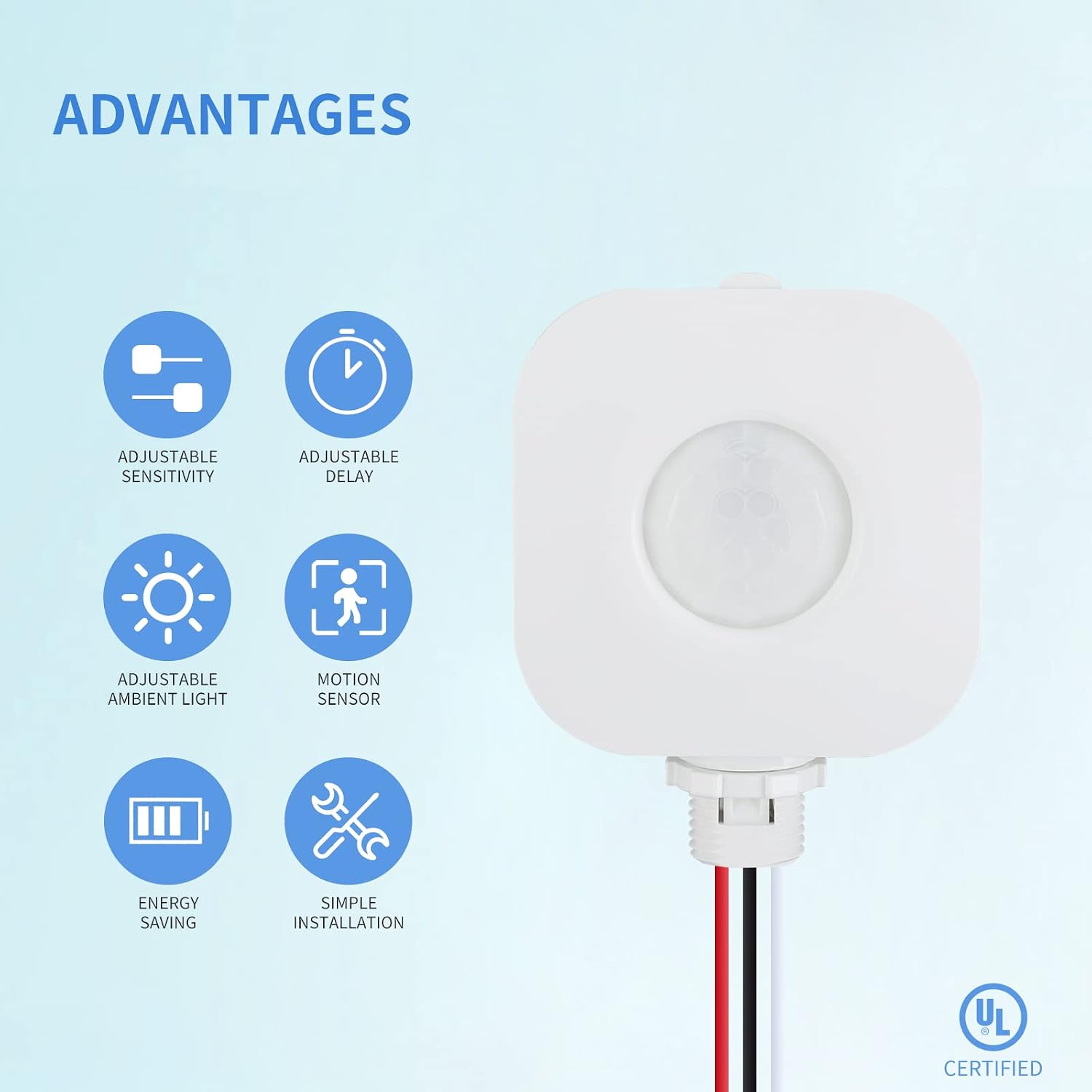
Check price on AmazonECOELER’s standout feature isn’t detection performance — it’s the plug-in shop-light mount. The sensor integrates directly with the plug socket on standard shop-light fixtures (the kind with a built-in AC outlet on the fixture housing). No electrician, no junction box, no wire nuts. Reviewers repeatedly call this out as genuinely clever, and it is: for a rented workshop, a barn, or a space where you can’t justify running conduit, it removes the single biggest installation barrier.
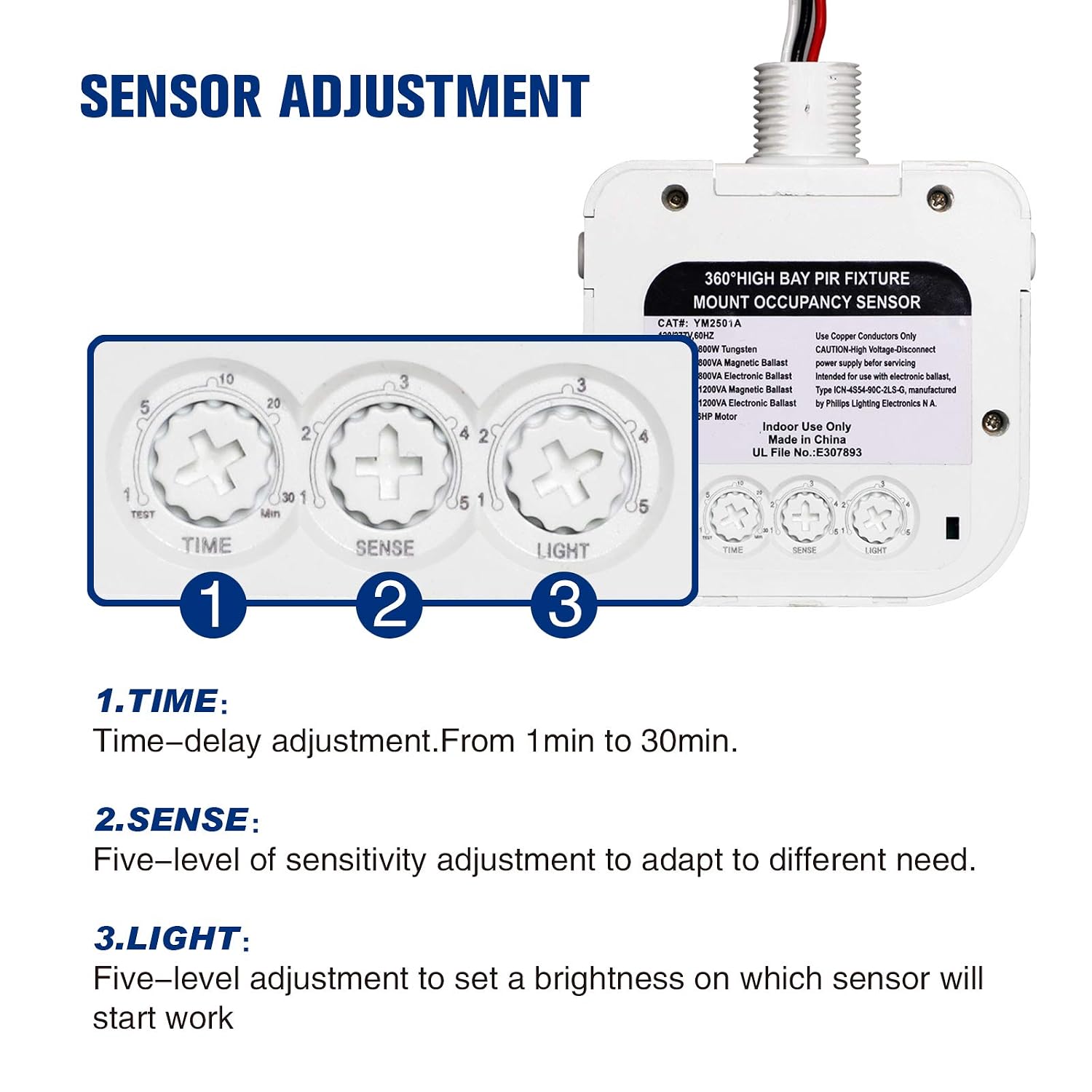
The ECOELER model reviewed here — identified by its product listing title rather than its inventory code, per editorial policy — adds a switchable dusk-to-dawn mode vs. 24-hour occupancy mode. A barn owner’s review is instructive: in dusk-to-dawn mode, the sensor suppresses the lights during daylight hours even if motion is detected — fine for most applications, but not if you need lights in a windowless interior stall regardless of ambient light. Switching to 24-hour occupancy mode removes the photocell logic entirely; the sensor then functions purely on motion. That’s a meaningful operational difference most competitors don’t offer at this price tier.
Detection range caveats apply. Accept the 20-foot spec as a ceiling, not a floor, and treat 12–14 feet as a realistic working radius in typical conditions.
If X, then Y: If your shop has existing plug-socket light fixtures and you want zero-electrician installation, ECOELER is the pick. If IR cameras share the space, verify the camera model’s IR wavelength before buying any PIR sensor.
Maxxima — Strong General Performance, One Hard Disqualifier
ECOELER
$13.59
In stock on Amazon
Check price on AmazonMaxxima ceiling sensors earn consistent praise for plug-and-play setup and reliable detection in standard residential garages without obvious range-overshoot problems. Owners in standard two-car garages report that detection feels natural — walking toward the door from the interior triggers the sensor before they reach the threshold in most installs.
But the IR camera false-trigger issue is not a minor inconvenience. Owners report lights cycling on every few minutes throughout the night, triggered by their own security cameras. Until Maxxima publishes revised filtration specifications that address this interaction, any install where IR cameras are present should rule Maxxima out. This is a use-case disqualifier, not a quality defect per se, but the spec sheet’s silence on it is a problem for informed purchase decisions.
If X, then Y: If your garage has no IR cameras and you want straightforward residential installation with reliable out-of-box performance, Maxxima is a reasonable choice. If you have any IR camera coverage in the space — rule it out until the manufacturer addresses the interaction.
RAYZEEK — Budget Entry, Geometry-Aware Buyers Only
ECOELER
$13.59
In stock on Amazon
Check price on AmazonRAYZEEK sits at the lower end of this price tier and the reviews reflect it: functional, affordable, but the doorway-trigger problem is real. For a single-car garage where you enter from a door at the side wall and the sensor can be mounted near that wall, you can mitigate the geometry problem by centering the sensor’s coverage over the entry path rather than the room center. For a larger space or a roll-up door entry where you need the sensor to trigger as you enter, the coverage pattern is likely to disappoint.
RAYZEEK’s value case is clearest for secondary spaces — a storage room off the garage, a utility closet, a small workshop alcove — where detection range is irrelevant because the room is small enough that any ceiling PIR will cover it, and cost is the primary variable.
If X, then Y: If the space is under 150 sq ft and detection at the threshold isn’t critical, RAYZEEK is a defensible budget choice. For primary garages, you’re giving up too much for the savings.
By the Numbers
| Sensor | Rated Range | Realistic Range (Owner Reports) | IR Camera Issue | Programming Complexity |
|---|---|---|---|---|
| Sensor Switch CMR 10 | ~1,000 sq ft | Strong; large garages confirmed Sensor — $52.80 | Not reported | High (manual button sequence) |
| ECOELER (plug-socket model) | 20 ft radius | ~12–14 ft typical ECOELER — $13.59 | Not reported | Low |
| Maxxima | ~20 ft radius | Adequate for 2-car garage ECOELER — $13.59 | Confirmed, multiple reports | Low |
| RAYZEEK | ~20 ft radius | Entry threshold miss common ECOELER — $13.59 | Not reported | Low |
Frequently Asked Questions
1. Will a ceiling PIR sensor trigger from the doorway, or do I have to walk into the room?
It depends on mounting location and lens geometry, not just the advertised range. PIR Fresnel lenses divide coverage into discrete lobes; if the sensor is centered in a deep garage, the outer detection boundary may not reach the doorway plane at standard ceiling heights. RAYZEEK reviewers flag this explicitly. The mitigation is to mount the sensor toward the entry side of the room rather than at center, or choose a unit with a wider-angle lens spec — look for coverage angle ratings of 360° horizontal and confirm the detection radius at your specific ceiling height, not just the maximum range claim. Control Engineering’s occupancy sensor selection guidance, published by CFE Media, addresses mounting-position strategy in depth.
2. Can an IR security camera cause the occupancy sensor to false-trigger?
Yes, and Maxxima buyers document this in detail. IR camera illuminators emit in the 850–940 nm band; if a PIR sensor’s optical filter and pyroelectric element aren’t well-isolated from near-IR, the camera’s illuminator can register as a thermal event. This is most pronounced in enclosed spaces where the IR illuminator’s output reflects off walls and ceiling. Until manufacturers publish filtration specifications that address this band explicitly, treat any IR camera co-location as a risk factor for any PIR sensor, with Maxxima currently showing the highest documented failure rate in owner reviews.
3. What is the difference between dusk-to-dawn mode and 24-hour occupancy mode?
Dusk-to-dawn mode layers a photocell (ambient light sensor) on top of the PIR: the light only activates if motion is detected and ambient light is below a threshold — so the sensor won’t turn lights on in a bright, windowed garage during the day. 24-hour occupancy mode disables the photocell logic entirely; the sensor responds to motion regardless of ambient light level. The ECOELER model reviewed here lets you switch between both modes, which is why a barn owner working in a dim interior stall praised it — they needed lights to activate during daylight hours in a space with no natural light.
4. Can I use one of these to control multiple shop lights wired in series?
The limiting factor is the sensor’s rated load capacity, not the series configuration itself. Most residential ceiling PIR sensors in this tier are rated for 150W–800W incandescent equivalent or a specific LED wattage. If your total fixture wattage falls within the sensor’s rated switching load, wiring multiple fixtures through one sensor is electrically valid. Check the spec sheet for maximum load in watts and minimum load — many LED-optimized sensors have a minimum load floor to avoid relay chatter. For high-wattage shop setups, the Sensor Switch CMR 10’s commercial-grade relay is the safer call.
5. Is the 20-foot detection range realistic in a real garage, or is it a best-case spec?
Best-case. As Control Engineering’s coverage of occupancy sensor selection for building automation explains (CFE Media), manufacturer range specs are typically derived under controlled conditions — optimal temperature differential, clear sightlines, no thermal noise sources. In real garages, factors including insulation quality, seasonal temperature, clutter obstructing the PIR’s line of sight, and heat sources like engines or propane heaters all degrade performance. Sensors Magazine’s analysis of PIR performance variables in real-world enclosures (Endeavor Business Media) reinforces the same point: thermal noise from the environment, not just distance, drives detection collapse. Owner reviews for ECOELER and RAYZEEK both put realistic working range at 60–70% of the advertised maximum. Plan your mounting strategy around 12–14 feet of reliable radius and treat anything beyond that as a bonus, not a guarantee.